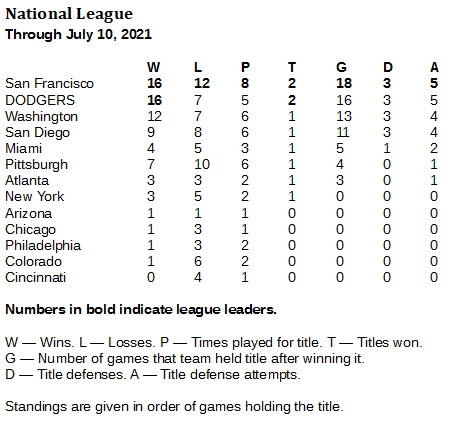
It was hard for the Dodgers to get into the Super League, but now that they're in, they've taken a pretty easy draw to the league lead at the 2021 All-Star break.
Fake news and alternative facts are the wrong way to follow public affairs, but a great way to follow sports
Thursday, July 29, 2021
With favorable slate, Dodgers lead Super League at All-Star break
Friday, July 16, 2021
2021 National League lineal turns East
The Dodgers, San Diego Padres and San Francisco Giants are among the early leaders in the 2021 race for the National League lineal championship, but the prize rested in the East as the All-Star break arrived.
Friday, June 18, 2021
Rockies rise to 2019 NL traveling title
The Colorado Rockies secured a berth in the 2021 Super League by winning the 2019 National League traveling championship on criteria.
Trying to work out the best way of determining the best lineal championship performance at the end of a sports season has proved, not surprisingly, to be a continuous process. Difficulties lie in many folds, for there are many ways to value these performances.
So, we'll keep tweaking until we think we have it right, or close enough to it. For the league-wide lineal baseball championships in 2019, we decided to make a slight adjustment, not in the criteria for determining the year's champion, but in the criteria for deciding which teams get to be considered.
For 2018, the first year, the requirement was at least two championships and at least three defenses, or one championship with six defenses. Second thoughts have ensued, complaining that the criteria under-valued championship defenses, which amounted to over-valuing championships (relative to defenses). Ideally, we want criteria that equally values challenging for the championship successfully, defending the championship successfully and competing successfully against the top contenders.
Anyway, the decision was made now to reduce the number of necessary defenses for a team with one championship down from six to four. So, two championships and three defenses comes to the same as one championship and four defenses. Either way, it's five series wins for the championship.
Along the same lines, then, we'll put the other qualifying levels at three championships with two defenses, four championships and one defense, and five championships with no defenses. In addition, however, any team that has won at least one championship will have its number of required defenses reduced by one if it has never failed a championship challenge. In other words, a team that only had one chance to challenge for the championship and succeeded needs only three defenses to qualify. A team with one title in two challenges still would need four defenses.
Tedious, we know, but it needs to be on the record. Going forward, that's how we'll run the lineal championships in baseball. We already have, however, published the inter-league championship for 2019, so we did that one the old way, but it would not have changed the outcome. In the National League, though, it amounted to two teams qualifying for the 2019 stat-off that would not have made it otherwise, and it made a difference.
Take a look again, if you'd like, at the standings and results from the National League in 2019, or any league in any year, and ask yourself which team should be named the champion. It's usually not obvious. We used to just eyeball it, but now we need a defensible decision method so we can have a more defensible decision, as the result of that decision determines a Super League berth for the next year.
First, as we've explained before, we have to decide which teams go into the criteria mix, in effect, becoming the finalists for the annual lineal championship. By the criteria we have just laid out, we get four clubs -- the Atlanta Braves, Colorado Rockies, Milwaukee Brewers and Washington Nationals.
Now, we set out the criteria. All four teams are considered by each criterion. The best team gets the full point for the criterion. If two or more teams finish tied at the top in some category, they split the point evenly. We have seven criteria. The team with the most criteria points wins. If it's tied, then we go to head-to-team among the teams that are tied. If it's still tied after that, we declare co-champions and the Elite Division berth goes to the team that has gone longest since being in the Elite Division. If it's still tied after that, then we declare a co-champion and no team goes to the Elite Division.
Next, we lay out the criteria and list the team that won, with the winning total, or average, if that's what it is:
1. Most championships. (Colorado, 4).
2. Most title defenses per championship. (Washington, Milwaukee, four each).
3. Best winning percentage in traveling championship games. (Atlanta, .641).
4. Most victories per time playing for the championship. (Milwaukee, 2.375).
5. Most games as champion per time playing for the championship. (Washington, 2.43).
6. Fewest failed challenges. (Colorado, 0).
7. Head-to-head record in traveling championship games (Colorado, 10-4. Others were Atlanta 7-8, Washington 4-5 and Milwaukee 3-7).
Add it all up and the Rockies won three categories of the seven, Milwaukee and Washington each won 1.5 and Atlanta won one.
Thus, the Rockies win the championship for the season, and the Elite Division berth, which they needed, as they didn't qualify in the pyramid.
We like the criteria system because if you ask the criteria why the Rockies won the championship, the criteria gives you a straight answer: Because the Rockies won the most titles, they won the title every time they challenged for it, they demolished the other contenders head-to-head for the title and no other team can make an equivalent case. All of that is right there in the information provided by the standings and results, but we need criteria to put that information through relevant questioning.
The Rockies did most of their work in April, taking the prize from the San Diego Padres on the road, then defending the championship four times. It would be the only four title defenses the Rockies would register all season, but three of them were against Atlanta, Milwaukee and Washington, saddling each with a failed challenge. That would loom huge on Criterion No. 6, which Colorado won almost entirely through that run of games.
The Rockies held on for 17 games of defense before losing it to the Arizona Diamondbacks in May. The Braves immediately snatched the prize from Arizona and tore out four defenses amounting to 15 games of title defense, pulling nearly even with the Rockies.
However, the Washington Nationals who took the championship with a two-game sweep from Atlanta May 28-29, then mounted a 17-game defense before the Braves took it back by winning two of three in Washington June 21-23. With the victory, the Braves not only stopped Washington at 17, but they also picked up the four games of defense, bringing themselves to the lead at 19, when they immediately split four with the Chicago Cubs, who took the tiebreaker.
Colorado returned to the fray in July rather fortunately. After winning the prize from the Reds, the Rockies immediately lost four straight to the San Francisco Giants. So, they get dinged for failing to defend, but they still claimed four games of defense, launching ahead of the Braves with 21.
Another victory in late August added seven games for the Braves, bringing their total to 26 before they visited Colorado on Aug. 26 to make up a game postponed by weather in April. By simply winning that game, 3-1, on a walk-off homer in the bottom of the ninth, the Rockies also added four games of defense despite being immediately swept four games by the Pittsburgh Pirates, so now they were up to 25, needing one more to tie the Braves. In addition, the Rockies stopped the Braves from accumulating more numbers.
Within a week, the Milwaukee Brewers won the title with a four-game sweep of the Florida Marlins, starting a torrid 15-2 title run with four title defenses that took them all the way from nowhere to the criteria leader before they visited Colorado for the final series of the regular season, Sept. 27-29.
The stakes were clear. The winner of the series would win the lineal title for the year. After the Rockies claimed an 11-7 win in the opener, they clinched the next day with a 3-2 win on Trevor Story's tenth-inning homer against Matt Albers.
Wednesday, June 16, 2021
Natties establish Southeast lineal championship
The Washington Nationals consolidated all the shares of the Southeast Conference lineal championship in late August 2019. At the end of 2019, and entering 2021, that championship belongs to the Atlanta Braves.
The Atlanta Braves ended the 2019 season with the Southeastern lineal championship, which had been consolidated at the end of August. The Braves will take the title into the 2021 season.
A mass of the play-down title shares, five of the seven, congealed in Cincinnati May 27-29, when the Reds and the Pittsburgh Pirates split a four-game series. The Reds, who entered the series with three shares, prevailed in the total runs tiebreaker (26-22), thus claiming the two shares entered by the Pirates.
By then, Tampa Bay had the other two shares, which they guarded until losing by runs in a four-game split on the road against Baltimore August 22-25. In the meanwhile, the five shares belonging to the Reds were transferred to the Washington Nationals, then to the Braves, then back to the Nationals, then Atlanta again, once more to the Reds and Washington in mid-August.
When the Nationals with five shares met the Orioles with the other two (in Washington, Aug. 27-28), a two-game split ensued. The Natties won the total runs tiebreaker, 8-6, and consolidated the championship.
Saturday, June 10, 2017
Offense dies as Dodgers drop NL traveling title
An offensive surge took the Dodgers to the National League traveling championship last week, and now an offensive slump has taken it away.
Losing two of three games this week against the Washington Nationals at Dodger Stadium, the Dodgers lost the traveling championship to the visiting club. The Dodgers scored four runs in the three games.
The Dodgers remain on top of the traveling standings with two titles and 13 games of defense. But the Nationals have the league traveler for the first time this season and become the eighth club this year to claim the title.
The downfall for the Dodgers is a batting order that is prone to strikeouts and double plays, but is not as likely as most other clubs to hit the ball out of the park. Strikeouts are everywhere throughout the game now, but so are home runs. Except that's not how it works with the Dodgers, who entered games of June 9 with the fifth most strikeouts (541), but tied for 21st in home runs (66).
In their eight games from May 31 through June 7, the Dodgers scored only 18 runs – 10 of them in a 10-8 win on the road against the Milwaukee Brewers on June 3. In those eight games, the Dodgers hit four homers and struck out 91 times – 11.38 strikeouts per game. In those games, the Dodgers batted .166.
Somehow, the Dodgers won three of those games. The outburst against Milwaukee was one, Clayton Kershaw's 2-1 win against Washington's Stephen Strasburg on June 7 was another, and a 2-1 win against the Brewers on June 2, when Kershaw out-dueled Jimmy Nelson.
If it seems that the Dodgers can't win a game unless Kershaw pitches or the other team can't pitch, that's right. At least for the last eight games.
Thursday, June 1, 2017
Nationals start strong in First Division
Wednesday, April 5, 2017
Two strong clubs, but no race, in Happy Chandler East
Instead, the Nationals won easily, going 49-25 and .662. The Blue Jays, at 44-33 and .571, finished four games back, and they weren't even the second-place team by the percentages.
That was the Pittsburgh Pirates, who were 30-21 and .588.
No challenge for Nats in Warren Giles League
The Nationals blew through this group with a robust 44-20 output.
Thursday, April 14, 2016
Mets cruise to 2015 East League title
Tuesday, May 12, 2015
East League: The Nationals are coming
Bryce Harper was the big star for the Washington Nationals the last couple of weeks, hitting six homers during a 12-game stretch. (Keith Allison/Creative Commons Attribution-Share Alike 2.0 Generic license).
By BILL PETERSON
Big Leagues in Los Angeles
Despite cooling off quite a bit in the last couple of weeks, the New York Mets remain the leaders in the East League.
But the New York Yankees are right with them now, and the Washington Nationals are gaining with a 10-2 run from April 28 through May 10. With that streak, the Nationals picked up 3½ games on first place, and now trail the Mets by three games. The Yankees are 1½ game behind the Mets.
The Nationals helped themselves quite a lot by winning three of four from the Mets at CitiField April 20-May 3, including back-to-back 1-0 victories by pitchers Gio Gonzalez and Doug Fister.
But the real trigger to this has been Nationals right fielder Bryce Harper, who hit six homers with five doubles and 17 RBI in those 12 games to go with a .356 batting average and a 1.319 OPS. As a team, the Nats batted .306 with 17 homers and an 852 OPS in those games, averaging 6.0 runs per game.
The Yankees have won 10 of their last 15 in the East League, reducing their deficit to the Mets from three games to 1½ games.
This week will be pretty light in the East League. During the early part of the week, the only league action involves the Yankees at the Tampa Bay Rays and the Toronto Blue Jays at the Baltimore Orioles. At the end of the week, the only two Eastern teams playing each other will be the Atlanta Braves and Miami Marlins.
Games of April 27
at Boston 6, Toronto 5.
at New York (AL) 4, Tampa Bay 1.
at Atlanta 8, Washington 4.
New York (NL) 3, at Miami 1.
Games of April 28
Toronto 11, at Boston 8.
at New York (AL) 4, Tampa Bay 2.
Washington 13, at Atlanta 12.
at Miami 4, New York (NL) 3.
Games of April 29
at Boston 5, Toronto 2.
Tampa Bay 3, at New York (AL) 2.
Washington 13, at Atlanta 4.
at Miami 7, New York (NL) 3.
Games of April 30
Washington 8, at New York (NL) 2.
Games of May 1
New York (AL) 3, Boston 2.
at Tampa Bay 2, Baltimore 0.
at Miami 4, Philadelphia 3.
at New York (NL) 4, Washington 0.
Games of May 2
New York (AL) 4, at Boston 2.
Baltimore 4, at Tampa Bay 0.
at Miami 7, Philadelphia 0.
Washington 1, at New York (NL) 0.
Games of May 3
New York (AL) 8, Boston 5.
Baltimore 4, at Tampa Bay 2.
Philadelphia 6, at Miami 2.
Washington 1, at New York (NL) 0.
Games of May 4
Tampa Bay 5, at Boston 1.
at Toronto 3, New York (AL) 1.
Philadelphia 5, at Atlanta 2.
at Washington 6, Miami 4.
Games of May 5
at Boston 2, Tampa Bay 0.
New York (AL) 6, Toronto 3.
at Atlanta 9, Philadelphia 0.
Miami 2, at Washington 1.
at New York (NL) 3, Baltimore 2.
Games of May 6
Tampa Bay 5, at Boston 3.
at Toronto 5, New York (AL) 1.
at Atlanta 7, Philadelphia 5.
at Washington 7, Miami 5.
at New York (NL) 5, Baltimore 1.
Games of May 7
at New York (AL) 4, Baltimore 3.
Games of May 8
at New York (AL) 5, Baltimore 4.
at Toronto 7, Boston 0.
at Philadelphia 3, New York (NL) 1.
at Washington 9, Atlanta 2.
Games of May 9
Baltimore 6, at New York (AL) 2.
at Toronto 7, Boston 1.
New York (NL) 3, at Philadelphia 2.
at Washington 8, Atlanta 6.
Games of May 10
at New York (AL) 6, Baltimore 2.
Boston 6, at Toronto 3.
New York (NL) 7, Philadelphia 4.
at Washington 5, Atlanta 4.
Games of May 11
at Baltimore 5, Toronto 2.
New York (AL) 11, at Tampa Bay 5.
Games of May 12
at Tampa Bay 4, New York (AL) 2.
Toronto 10, at Baltimore 2.
Tuesday, May 5, 2015
2013 Second Division standings and summary
2012 Third Division standings and summary
Monday, April 27, 2015
East League: Mets extend lead
Mark Teixeira had the most powerful week in the East League, crushing five homers and running a 1.429 OPS in six games (Keith Allison/Creative Commons Attribution-Share Alike 2.0 Generic license).
By BILL PETERSON
Big Leagues in Los Angeles
So, the New York Mets struggled against the New York Yankees during the weekend, losing two of three at Yankee Stadium.
But the Mets aren't struggling otherwise. They beat the Atlanta Braves three straight to start the week ending on April 26 and increased their lead in the East League from 1 1/2 games over the Braves to three games over the Tampa Bay Rays. Though the Yankees won their series against the Mets, they still lost one-half game because they were playing in Detroit while the Mets were sweeping the Braves.
And the Mets did rather beat themselves in the April 26 rubber game with the Yankees, making four errors that led to two unearned runs, the difference in a 6-4 Yankees victory. Two of the errors came after balls hit by Alex Rodriguez, both after Rodriguez had homered earlier in the game.
No team in the East had a better week than the Rays, who moved up from fifth place to second place after winning five straight through April 26. The Rays picked up a game on first place and now are three games down.
More dramatically, the Rays picked up huge in the South Division, coming from 2 1/2 games down to take the lead by one-half game. They can thank the Braves, who held the division lead a week ago, then lost three straight against the Mets and two of three against the Philadelphia Phillies, all on the road.
The Mets will go on the road at the start of this week against the Miami Marlins, who ended the week just completed with five straight wins against the Phillies and Washington Nationals. The Mets swept the Marlins in four at home earlier in April. After that, the Mets go home against the Nats, who have, so some surprise, distinguished themselves with their last-place occupancy in the East at this early date.
A series of some import at the start of the week will put the Yankees against the Rays at Yankee Stadium.
Wednesday, April 22, 2015
2010 Fourth Division standings and summary
By BILL PETERSON
Big Leagues in Los Angeles
The Fourth Division in this competition began with the three teams in each Major League with the worst records from 2009 — the Baltimore Orioles, Cleveland Indians and Kansas City Royals in the American League and the New York Mets, Pittsburgh Pirates and Washington Nationals in the National League.
(The Mets and Arizona Diamondbacks actually tied for the third-worst record in the NL at 70-92, but the Diamondbacks were placed in the Third Division for their 5-2 record against the Mets in 2009).
The Mets quickly and easily outclassed this tawdry field, blitzing to a 21-10 campaign to win easy promotion to the Third Division for 2011. No one else was especially good, but the Nationals at least finished with a winning record (19-17) to win the second promotion.
This was a bad lot in 2009 and remained that in 2010, except the Mets, who made a bid for .500 at 79-83 during the regular season. Every other team in this group won fewer than 70 games during the Major League season.
Monday, April 13, 2015
2012 East League standings and summary
Wednesday, April 1, 2015
Cinderella is dead
By BILL PETERSON
Big Leagues in Los Angeles
The connection between the 162-game baseball season and the World Championship is broken, and barely hanging together.
No one else seems much bothered by this, but we were just last October treated to a World Series between a fourth-place team and a fifth-place team – and the fifth-place team won. The San Francisco Giants and Kansas City Royals entered the 2014 postseason as wild cards in their leagues. The Royals were the American League's first wildcard (the fourth-place team) and the Giants were the National League's second wildcard (the fifth-place team). We had seen fourth-place teams win the World Series already. That was bad enough. Now, with the Giants taking the 2014 World Championship, we've seen a fifth-place team win the World Series. The World Series.
Complaints about fifth-place teams in the World Series will strike folks as crotchety. Anybody younger than about 40 by now is likely to think inclusive playoffs are the way of the world, the way God planned it. It's not. It's a creation of the suits and the television executives, which doesn't make playoffs bad. But expanded playoffs do not reward excellence over 162 games, so much as they reward pretty goodness.
Some of us who are a long way past the sunny side of 40 remember when you didn't go to the baseball playoffs without some kind of a meaningful championship, at least a division. There was even a time, for those of us well on the dark side of 50, when they didn't even have playoffs in baseball. They played 162 games, undivided, with the best record in each league entering the World Series. You always knew the two teams in the World Series legitimately were the best in their leagues by the measure of 162 games. The World Series in those days, and for more reasons than that, was a huge event across the national popular culture such as it no longer is.
Everybody loves playoffs, all-or-nothing playoffs in which anything not pertinent to the moment no longer matters. And playoff baseball is exciting. Understood. The task here isn't to complain about that (though we are happy to do it, robustly, and at length) so much as to note the dissolution of 162 games as a measure of a baseball team and, maybe, to do a little tiny something about it.
All of the other big spectator sports have big playoffs. Good for them. The National Hockey League (NHL) and the National Basketball Association (NBA) each has 30 teams, each plays an 82-game regular season, and neither bothers to eliminate even half of its teams before the playoffs. In neither case is there a compelling reason to even follow the regular season, unless you absolutely love those sports – and no one is saying you shouldn't. But the regular season competition simply doesn't matter.
In the NBA right now, they're fighting out the last three weeks of the regular season to work out which two teams that can't even break even are ticketed for a crack at the big prize. Hardly a tournament of champions. In the NBA and the NHL, it is not unprecedented for an eighth-place team – a mediocre team – to heat up during the playoffs, catch a bounce and go to the finals or even win the league championship. Congratulations to those teams. But, then, what's the point of that long regular season? Why invest in it? And what does that championship actually say about itself? If a mediocre team can win the championship, then the championship no longer demands excellence. It demands merely that some team find its way through a good month, the way any team can find its way through a good month in a season.
In the major leagues right now, a team that puts up six excellent months is out of the running after losing three straight games to a fairly good opponent in the playoffs. And we now, much too often, don't see the best teams in the World Series. We too often see teams with little to say about 162 games, except that they weren't terrible.
Expanded playoffs are here to stay. It's where the money is. Playoffs make great seasonal television programming. That's why television networks pay what they pay for the rights. But they don't make great champions. They make "unlikely" champions, which now have become so likely that they have lost their novelty power and no longer are even good stories. When Cinderella gets out more than Paris Hilton, then she's no longer Cinderella. Now, she's Kim Kardashian. Cinderella is dead.
We never like playoff expansion, per se, but we thought, foolishly, that the fifth team in each league would dilute the wild cards. If the wild cards were to play each other in a one-and-done game, needing to probably cook their best starting pitchers before the winner went on the road against the club with its league's best record in the next round ... maybe that would be enough hoops to keep them from darkening the World Series. Good enough, said this corner. Gone, we thought, were the days when some team that didn't win anything all year could whisk through the playoffs on a lark and claim the World Championship.
But it took all of three seasons before that wonderful reverie was smashed. So, the Giants and Royals nudged into the playoffs last fall and we saw what happened. Clubs that made it tick all year, like the Angels and Dodgers, like the St. Louis Cardinals, the Washington Nationals, Detroit Tigers and Baltimore Orioles – clubs that attracted our attention for 162 games – were nowhere to be found near the big stage.
Call an old guy old-fashioned for wanting to see the best teams play for the World Championship. Call him all the bad names you want. He doesn't care, because he remembers when having the best teams play for the championship was the point, and that still makes a damned lot of sense to him.
And now we hear that the central office is concerned that World Series viewership is down because the game isn't national enough. We believe, actually, that baseball's problem is that isn't regional enough, but that's another topic for another day. More to the point, though, how can you expect the World Series to have a national following when the teams that are playing in it didn't develop a national following during the six-month grind of the regular season?
Of course, the Giants have established themselves in the last few years as a great tournament team, but they were just another team grubbing for a desperate playoff spot last September, which is to say they didn't take the imagination captive. And who, except for Royals fans and hard-core baseball fans, really cared about the Royals before the two final weeks of last September? If capturing the largest possible audience for the World Series requires capturing the non-fan who might just hear about baseball on the side, then putting teams in the World Series that haven't even been mentioned to the non-fan long before then won't get it done, because Cinderella is dead.
Televison viewership for World Series now is just a little better than one-third of what it was 30 years ago. Starting from 1985, the five highest years for average World Series viewership all took place between 1985 and 1991 (1985-8, 1991), with a range of 34.5 million to 36.4 million average viewers. The five lowest years for average World Series viewership all have taken place starting in 2008, and four of those are in the last five years (2008, 2010, 2012-4), with a range of 12.7 million to 14.9 viewers. From 1985-8, the average World Series rating ranged from 23.9 to 28.6, and the average share ranged from 39 to 46. In the last four years, the average World Series rating has ranged from 7.6 to 10.0, and the average share has ranged from 12 to 16, setting records for disinterest in the championship of Major League Baseball.
Through 1980, by the way, the World Series routinely drew shares of 50 or better. By contrast, the 2014 World Series of fourth- and fifth-place teams was on track to be the worst rated World Series ever (averaging 7.4 through six games), but that Game 7 was quite something, and it pulled a 13.7 rating to bring the whole enterprise up to 8.3 with a 14 share.
Now, 30 years was a while ago, but it wasn't the Stone Age. We didn't have portable telephones and we didn't have the Internet, but we had cable television and VCRs, we had all the same football, basketball and hockey. People read books more, took in more live music and went to more movies. We had plenty else to do. And we still watched the World Series, going on three times as much as we do today.
So, this idea that people don't watch the World Series now because we have so many more options is unavailing at best, vapid at worst. There are at least four or five better explanations, and one of them is right here. Too often, the World Series doesn't resemble the baseball season into which we have invested every day of the last six months. It feels a bit like a cheat. A guy not far from here is as likely as not to throw his hands into the air during the World Series and say, "Another Cinderella story! How unlikely!"
And he will pay his perfunctory, perhaps dutiful, attention to the World Series, but it all feels rather flat. The Cinderalla story is old and tired now, dead even. And the price we pay to perpetuate it is fifth-place teams in the World Series. It's barely worthwhile for anyone except for the central office, when it cashes those national TV checks – $500 million per year from FOX and $300 million per year from TBS. For ratings of about 7.5 on a good night. (ESPN also pays MLB about $700 million per year, though its postseason is limited to one wild-card game per year.)
It was mentioned here some time ago that we would try to offer something constructive and not spend the whole time complaining about expanded playoffs. Consider that another broken promise. Couldn't help it. But we can still redeem 162 games. Here are a few ideas.
Tuesday, September 16, 2014
Kershaw no Koufax ... and thank heaven!
The closest to it that we will see today is this composite of Kershaw's last four years, 2011 through this point in 2014. It dazzles, but it does not compare.
-
The Toronto Raptors controlled the pro basketball traveling championship far more than any other team in 2017-18, but the Golden State Warr...
-
The 2017 African traveling soccer championship, which lasted only 16 games, went through seven clubs without leaving South Africa. At the e...
-
The San Jose Knights and Vegas Golden Knights were the two top teams in the Western hockey traveling championship for 2018-19, but the Duck...