Showing posts with label Los Angeles Dodgers. Show all posts

Thursday, July 29, 2021

Reviewing 2020, first half of 2021, in triennial baseball leagues

Of all the baseball leagues we run on these pages, the only one that actually happened in 2020 was the triennial regional alignment corresponding with the correct alignment for interleague play. We can compare 2020 with the first half of 2021.

It's the All-Star break in 2021 and we still haven't gotten around to publishing the results from the only baseball competition on these pages that survived coronavirus in 2020, the triennial regional leagues.

We track these leagues during the years, ideally one out of every three, in which MLB aligns the divisions for interleague play so east plays east, etc. In an ordinary season, if every team in both central divisions play each other, we end up with a round-robin, though still unbalanced, schedule of 96 games. And if we get rid of the National League and American League labels, the 10 teams in each of the three resulting leagues can be divided into two regionally interesting divisions.

As it happens, the ideal alignment for running these leagues actually has been popping up much more than every three years, due to travel cautions over coronavirus. Indeed, 2021 is the third year of the last four to be aligned this way, and the second year in a row. We tracked for the first time in 2015, the alignment returned in 2018 and it was going to come back for 2021, anyway, but 2020 was forced by the virus.

So, when we look at these leagues now for 2020, we can compare them directly with how they shape up at the All-Star break in 2021.


We'll start with the East League, where the Boston Red Sox show their cyclical tendencies. In 2015, the first year we tracked, the Red Sox were all the way down from their 2013 World Champions, 78-84, and in the East League they were 48-48, second division overall and second from the bottom of the North Division. 

The 2018 edition ended with the Red Sox dominating, as they actually did. In the East League, they were 68-28, 11 games ahead of the nearest contender. Over the full season, they won 108 during the regular slate, then won the World Championship with three playoff wins in which no opponent beat them more than once.

But we revisited the triennial leagues prematurely in 2020 because of coronavirus, and the timing was poor for the Red Sox, who perhaps didn't have enough time in a 60-game campaign and finished 24-36. Then again, Chris Sale was out for the year with Tommy John surgery, so it might have been to no avail.

We don't have this in the agate, but the playoff championship in the 2020 East League would have gone to the Rays. If two division champs in one of these leagues meets in the playoffs, we count that as the league championship series, and the Rays beat the North Division champs, the New York Yankees, in a five-game ALDS.

We come now to the All-Star break in 2021 and the Red Sox, still without Sale, are leading the East League, holding on tight with a two-game lead on the Tampa Bay Rays, who blitzed through last year's regional season with a 40-20 record, winning the East League overall and the East League South on their way to a six-game loss to the Dodgers in the World Series.

The very next year, this year, the Yankees are hapless against Eastern competition, 21-30 in this East League, protected from the bottom only by the Baltimore Orioles. Thus, it looks like the East League in 2021 will come down to the Rays and Red Sox, though the Toronto Blue Jays, third-place at the break, can be influential, as they are in the same Major League division.


The difference a year makes in the Center League is rather stark. In 2020, the Twins blew through a 60-game season at 36-24. They were the regular season champions across the league, the premiers, as they are sometimes called in Australia. 

At the All-Star break in 2021, the Twins were 39-50, a .438 winning percentage. In the Center League, they were much better, 24-27, .474. In the Center League, they're a middle entry, the top team in the second division. In the North Division, they're fourth out of five.

The Twins nosed out the Chicago White Sox and the Cleveland Indians by one game and the Chicago Cubs by two in a thrilling race last year. Through Sept. 18, the White Sox held a two-game lead on the Cubs, a three-game lead on the Twins and a five-game lead on the Indians. But the White Sox lost seven of their last nine. A six-game losing streak during that span involved getting swept four in Cleveland. Meanwhile, the Twins were winning four in a row, including two against the Cubs. By the final weekend, the Twins were a game up on the Sox, two up on Cleveland and three up on the Cubs. 

The Twins lost two of three during the final weekend at the Cincinnati Reds, who were fighting to enter the expanded playoffs. The Indians won two of three at home against cellar-dwelling Pittsburgh Pirates and the Cubs beat the Sox two out of three at the South Side venue. 

As the visiting Twins licked their wounds in Cincinnati, having lost a chance to clinch the Center League by losing, 5-3, on the final day of the season, the Cubs and White Sox were putting the finishing touches on a strange game. A loss by the Twins and a Sox win would tie them atop the final standings, and the Twins certainly lost. But anyone watching the scoreboard would also have given up on the Sox, who trailed, 10-1, after seven innings.

In the eighth, new Cubs reliever Brailyn Marquez really needed to just throw strikes with a 10-1 lead and six outs to get. But he walked the first two batters of the eighth before wild pitching them to second and third. A ground ball scored the lead runner. The next hitter struck out. The inning should have been over. Then, a walk, a hard single that advanced each runner two bases, a wild pitch, a double ... Then a new pitcher, another wild pitch and another hit. Five runs brought the White Sox within 10-6.

The second Cubs pitcher in the eighth, Duane Underwood, Jr., allowed a leadoff single in the ninth, followed by Yasmani Grandal's homer. 10-8. Two outs later, with a runner at third, still another reliever, Andrew Chafin, struck out Nomar Mazara looking at a 2-2 pitch. Game over. All around Minnesota, we presume, toasts were raised to Andrew Chafin for helping the Twins win the Center League and its North Division. The Cubs got to spoil the White Sox ... Chafin, by the way, was having quite a nice year for the Cubs in 2021 as a specialty left-hander out of their bullpen before they traded him just now to Oakland.

At the All-Star break in 2021, the White Sox and Indians have returned as contenders, but the Twins and Cubs have not. Instead, we see the Reds sitting one game behind the Sox at the pause. The Brewers, the top team in the 2021 NL Central, are strangely low in these standings, seven down at the break. In fact, the Brewers swept three from the Reds right after the break, and later won two of three from the White Sox, so they have moved to within five games of first place ten games after the break.

We've seen the Dodgers run hot before. The 41-8 run in 2013 was one for the ages. But the Dodgers were on just a slightly slower pace during the 2021 regular season, 43-17. Play at the clip over 162 games and you're finishing with 116 wins. Not happening.

So, the Dodgers won the West League without a fight. The San Diego Padres, up and coming, still were close to a week behind the Dodgers in the end. After the strong third-place Oakland Athletics, the remaining seven teams in the 2020 West League finished with losing records.

Flash forward to the West League in 2021 and we've got a smoking race with the Dodgers, Padres and San Francisco Giants all within a game of the top, and the Houston Astros three games down.

That was at the All-Star break, these standings. Since then, and including games through July 28, the Dodgers have found rough sledding in the west, going 6-6, including four losses in six games to the Giants. Those are the only games the Giants have played in the West, while the Astros were 5-1 against the West and the Padres were 1-1.

Put it all together and the Dodgers were tied with the Giants in first place, one game ahead of the Astros and 1½ ahead of San Diego.


With favorable slate, Dodgers lead Super League at All-Star break

It was hard for the Dodgers to get into the Super League, but now that they're in, they've taken a pretty easy draw to the league lead at the 2021 All-Star break.


By couple of whiskers, the Dodgers missed out of the first season, 2019, of what we then were calling the Elite Division, but now are calling the Super League.

The Dodgers finished fifth in the 2018 First Division and barely lost out on the National League traveling championship. In each case, their downfall was the Arizona Diamondbacks, who finished barely ahead of the Dodgers in the First Division and the traveler. The main culprit was Arizona's 9-4 record against the Dodgers in games for the lineal title.

The Dodgers crept into the Super League for 2020 with their fourth-place finish in the 2019 First Division. Of course, we didn't actually play the Super League in 2020 (coronavirus, and all of that), so the 2021 Super League really is the 2020 Super League, a year late.

Here, the Dodgers received a quite favorable draw. They came to the All-Star break 20-9 in the Super League, first place. This occurred largely because about half of their games, 14 of them, came against the bottom two teams in these Super League standings, the Colorado Rockies and Washington Nationals. The Dodgers were 13-1 in those games, so 7-8 against the rest of the Super League.

Hard to argue against the Nationals being in this Super League. They did, after all, win the World Series in 2019, the year from which they qualified. But we're picking it up two years later, rather than the usual one, and the Natties aren't the same team. 

The Rockies aren't one of the illustrious teams in the game, but they have been in both Super Leagues, 2019 and 2021, qualifying the first time in the pyramid and this time with a lineal championship. They barely finished last in the 2019 Super League (then called the Elite Division) by our adjusted winning percentage, but ended up one-half game out of the basement in that column, buttressed by the Boston Red Sox. This time, they are buttressed by the Nationals.

There's still a race here, but barely. The Dodgers had 23 games remaining in the Super League, 12 of them against Colorado. They also were slated for two games with the Houston Astros, three with the Philadelphia Phillies, three with the Atlanta Braves and, at the very end of the season, three at home against the Milwaukee Brewers. Those last four named are the next four teams in the standings, all coming to the break between  3½ and 4½ games behind the Dodgers.


Friday, July 16, 2021

Second Division race highlights 2021 baseball pyramid at break

Halfway into the 2021 baseball season, the Second Division is producing a race such as we have never seen. All eight clubs are separated by less than two games.


A look at the standings through the baseball pyramid at the All-Star break reveals a thick race at the top and in the middle of the First Division, an incredibly tight Second Division from top to bottom, little suspense in the Third Division and another quandary such as only the baseball Fourth Division can produce.

Starting at the bottom, we see the Chicago White Sox on a clear path to winning the Fourth Division and entering next year's Third Division and Super League. They are clearly the best team in the American League Central, and it happens that the Fourth Division contains two divisional underlings, the Kansas City Royals and Detroit Tigers, against whom to ring up many victories.

A different circumstance confronts the San Diego Padres, who have emerged this season as a national factor across the big leagues, but they are trapped in this Fourth Division with no one to play. 

In no other ordinal division of any other sport that we track on these pages do these sorts of problems arise, because the other sports play some kind of round robin schedule. But baseball's schedule, being imbalanced as it is, sometimes puts us in a tough spot with the Fourth Division. The problem is intensified because the division has only six clubs, rather than eight.

It often happens, like this year, that some team just stomps through the division, and it's hard sometimes to qualify a second club for promotion. Various rules have been tried here, and remain in force. But the Padres are "trapped," as it sometimes happens, because they're a division that lays out so they only get seven games, all against the Miami Marlins.

We do have a precedent in the Fourth Division that amounts to making the Padres eligible for promotion if they win five of those seven games. If they don't, we might have a problem, because it's likely every other team in the Fourth Division will have a losing record, except the White Sox. If the Padres win four, this becomes quite thorny. 

We might end up biting the bullet and saying that just in this one special case, the Fourth Division in baseball, the second promotion will be a judgment call. Hate to do that. Hope we don't have to. Because if you're looking at the teams in the Fourth Division, the White Sox and the Padres are the teams that have to go up. The White Sox will make it. And one supposes the Padres would make it if they played enough games. They might end up making it, though, simply because no one else reaches a winning record. 

In that case, we would have to suspend certain minimum requirements for promotion, but that sometimes becomes necessary to promote two Fourth Division teams. And why is it necessary to promote two Fourth Division teams? So that two Third Division teams can be demoted. There's usually no problem producing two teams that deserve it.

In the Third Division, we have no race to speak of. The San Francisco Giants and Seattle Mariners have raced way out in front of the pack, and it's likely they will be the two clubs promoted to next year's Second Division and Super League. At the bottom of this pile, we find the Pittsburgh Pirates and Texas Rangers, both apparently completing the long decent to the bottom tier.

The Rangers played among kings in the early days of this pyramid, which began tracking in 2010, but they now are facing their second straight demotion and the queasy reality of the Fourth Division for the first time. The Pirates were an original Fourth Division club in 2010, but they won it in 2012 and then won the Third Division in 2014. They spent five years in the Second Division before their demotion off 2019 and now they, too, face their second straight demotion.

Our Second Division is the stuff that dreams are made of, all eight teams riding within 1½  games of each other with many games remaining for each of these teams. The schedule lightweight here is Oakland, which has nine of its 22 Second Division games remaining. Everyone else has 15-20 games remaining. The A's come out of the All-Star break with a Second Division home series against the Cleveland Indians.

This is one division where every game is going to count. The top two finishers go to next year's First Division, and the top three finishers will be in the Super League. The bottom two finishers are going down. 

This is a tough, even assembly of teams, and one can see it from the fact that the Red Sox are 11-10 here. In every other division we run, and in the real standings, too, the Red Sox are a behemoth. But in this Second Division, they are 11-10.

One benefit of introducing the Super League is that it makes the whole First Division more interesting. There is a race for championship in the top tier, but, obviously not a race for promotion, so putting the top half of the First Division into the Super League raises the stakes in the middle of the league. 

When all the smoke clears, the only teams in the First Division now left standing still are the fifth-place and sixth-place teams, who occupy a middle station between Super League glory and Second Division banishment. They merely get to remain in the First Division.

We're pretty sure by now that the Arizona Diamondbacks will be banished, as they reached the All-Star break 3-21 in the top level. We ended up skipping 2020 in the pyramids because the teams didn't get around enough, but it remains that games were played, timed passed and the Diamondbacks declined so much from 2019 to 2021 that they are misplaced and not even competitive in this year's First Division. 

If we could have played the pyramids in 2020, the Diamondbacks would have been demoted then, probably, and they now would be fighting to stave off relegation to the Third Division. Instead, they're getting their brains beat in against the First Division.

At the top of the First Division, the Dodgers are one-half game ahead of the Milwaukee Brewers, no doubt a benefit of having the Diamondbacks in this company. A mere two games separates the third-place St. Louis Cardinals from the sixth-place New York Yankees. Add another half-game and we can throw in the Minnesota Twins, if they actually can win enough games against this group to reach the top half.


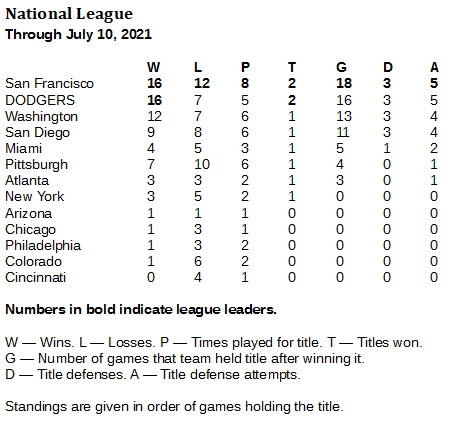
2021 National League lineal turns East

The Dodgers, San Diego Padres and San Francisco Giants are among the early leaders in the 2021 race for the National League lineal championship, but the prize rested in the East as the All-Star break arrived.

The National League traveling championship spent the first two months of the season on the West Coast, so the Dodgers, San Diego Padres and San Francisco Giants are among the contenders at the All-Star break.

But the break came with the championship crawling along the East Coast, passing successively to the Washington Nationals, the Miami Marlins, the Atlanta Braves and, later, the New York Mets. The Mets are the title holder at the pause, and they will put it on the line at home against the Atlanta Braves July 26-29.

It seems, though, that no team east of the San Joaquin Valley has the goods to sustain a championship streak. Perhaps the Milwaukee Brewers can do it, but they, and the St. Louis Cardinals, are the two clubs in the NL yet to play for this championship.

The Giants controlled the championship for most of a month, from May 9 to June 6, playing for it consistently during that period. In that time, the Giants won the title twice and defended it three times, losing only to a challenge to the Dodgers, but immediately winning it back in a counter-challenge.

Then the Giants ventured to Washington and lost two of three June 11-13. The title has been in the east ever since.


Friday, June 18, 2021

Fourth year of four-by-four crowns new champions

The Minnesota Twins had a huge year in the 2019 four-by-four, winning the Northwest Conference and each of their league divisions. 

The baseball four-by-four, in its fourth year in 2019, produced two teams winning their conferences for the first time and three clubs winning league titles for the first time.

The novelty did not extend to the Southwest Conference, where the Houston Astros beat out the Dodgers for the second straight year. In the Northeast, the Cleveland Indians won for the second time in four years after winning it in 2017.

However, in the Northwest, the Minnesota Twins produced a fantastic season. They became the fourth team in the conference to win it in four years, following the Chicago White Sox, Seattle Mariners and Colorado Rockies. The Twins also won both divisions as which the conference functions, becoming the first Northwestern team to win the conference and both divisions.

In the Southeast, the Atlanta Braves broke the Washington Nationals' stranglehold on the title. The Natties tied for the championship in 2016, then won it outright in 2017 and 2018. In 2019, the Braves outlasted Washington by 1½ games. But the conference would play out a little differently as league divisions.

In the East League, for example, the Tampa Bay Rays won the South Division by one-half game and six percentage points over the Braves. For that, the Rays were considered against the North Division champs, the New York Yankees, for the East League championship. Because the Yankees won the head-to-head meetings, 12-7, they were named the league champion.

In the South League's East Division, the Rays and Braves finished all but deadlocked. The Rays got the nod because, ultimately, we go by weighted winning percentage here, but the difference was less than a percentage point. The Braves had a one-game edge, but the percentage went to the Rays. 

As the East Division champs in the South League, the Rays were pitted against the Dodgers, who won the West Division over the Astros. The Rays won the title. They were 2-2 against the Dodgers head-to-head during the year, and they held a 24-22 advantage in runs.


The Southwest Conference's other division, the South Division of the West League, ended with the Astros ahead of the Dodgers by 10½ games. However, the Astros could not prevail as the West League champions, as they lost four of seven meetings during 2019 against the Twins, who won the West League's North Division.

The Twins were not so fortunate in their guise as the West Division champions of the North League. As such, they had to contend for the North League championship against the East Division champion New York Yankees, and that pairing almost never goes well for the Twins. The Yankees swept the Twins, 3-0, in an American League division playoff series, claiming the North League championship.


Yankees win 2019 First Division

The New York Yankees could have been caught on top of the First Division during the 2019 playoffs, but they weren't. They finished ahead of the Houston Astros and Tampa Bay Rays.


Of all the sports in 2020, none took a worse hit for timing from the coronavirus than Major League Baseball (MLB), which was half into spring training when all went dark in mid-March.

The process of starting baseball again in 2020 was labored, in more ways than one, but the solution landed on playing as, in effect, three separate leagues during the regular season, then as two leagues in the postseason. The season, only 60 games, isn't enough for teams to really get around. 

So, we decided to suspend the usual alternative league configurations in baseball for 2020, simply because they weren't played. Same with the traveling championships. As an example, Colorado ended 2019 with the older circuit's lineal championship, but defending it in 2020 would have been a matter of just doing it against the four other clubs in the National League West. What's the point?

The only exception is that we ran the original version of the East, Center and West Leagues, as the compromise schedule in 2020 was accommodating Unlike the MLB season, the regional leagues here actually produced some interesting results.

The 2020 schedule also made the pyramid and the Elite League not feasible. Which means that when we pick these up in 2021, we will pick up from the 2019 results.

Let's, then, review the pyramid from 2019.

In the First Division, the New York Yankees entered the postseason in firm control of the lead. However, by its nature, the First Division is bound to produce many playoff teams and there's no telling in advance how the postseason will change the standings. 

It happens that the three leading First Division teams at the end of the regular season – the Yankees, the Tampa Bay Rays and the Houston Astros – all went to the American League playoffs.

Down two games to the Yankees, the Rays had the best chance of catching them in the playoffs. If they could have taken down Houston in the divisional series, even if it took five games, they still could have gone in front of the Yankees by sweeping them in the championship series. It was a stretch.

And it didn't happen, anyway. The Astros eliminated Tampa Bay in the divisional round, so they entered the championship series needing a sweep against the Yankees just to reach a tie at the top. As it worked out, the Astros won the championship series in six games and the Yankees pulled through the postseason with a one-game lead in the First Division.

So, a little drama came to us, but the outcome wasn't much in doubt. The Yankees won the First Division, the Astros rallied to second, the Rays dropped to third after losing their playoff series to the Astros, and the Dodgers finished fourth. All four teams will be in the 2021 Elite League, as the 2020 version was suspended because of adjustments to the coronavirus.

On the bottom of the top division, the Cleveland Indians and Boston Red Sox struggled mightily in the 2019 First Division and now will try their luck in the Second Division as the new relegants in 2021.

The Milwaukee Brewers faced little opposition in the 2019 Second Division, ending with a five-game cushion on top, with the Minnesota Twins and the Washington Nationals behind them. The Twins will join the Brewers in the 2021 First Division. Both, along with the Nationals, will be in the 2021 Elite League. 

The Pittsburgh Pirates and Texas Rangers continued their declines in 2019 and finished that season at the bottom of the second tier. They are going to the Third Division in 2021.

The free-agent signing of Bryce Harper didn't help the Philadelphia Phillies into the 2019 National League playoffs. Did it help the Washington Nationals win the World Series? Either way, it might have been the difference for getting the Phillies out of the Third Division. The Oakland Athletics actually won the third tier, with the Phillies in second place, a robust 3½ games behind Oakland. 

The Phillies finished a mere one-half game ahead of the Seattle Mariners in the Third Division. That difference matters in these pyramids, because the top two Third Division teams are simultaneously promoted to the next season's Second Division and Elite League, while the third-place club gets neither.

The two worst teams in the American League Central Division, the Detroit Royals and Kansas City Royals, also were the worst two teams in the 2019 Third Division. Each is going to the Fourth Division in 2021.

The winners in the Fourth Division, easily, were the Atlanta Braves, who will be promoted to the Third Division and the Elite League in 2021. The Cincinnati Reds, finishing second in the Fourth Division, will go up to the Third Division in 2021.


Wednesday, June 16, 2021

No winner as Southwest launches lineal in 2019

After a full 2019 season of attempting to play down the Southwest Conference for a lineal champion, the task was not yet completed. The Houston Astros and Arizona Diamondbacks each ended the season with four of the eight title shares.


The basis of the four-by-four baseball standings on these pages is a division of the big league baseball markets into four ordinal directions (northeast, southeast, southwest and northwest, going clockwise) and, intending the most equal distribution and geographic integrity possible, placing the teams into these four new "conferences."

In addition to playing each year for this important conference championship, these ordinal conferences also are purposed as divisions in corresponding new leagues based on cardinal directionality (north, south, east and west). Thus, the Northeast Conference is simultaneously the North Division of the East League and the East Division of the North League. 

As the East Division of the North League, the Northeast partners with the Northwest, which is the West Division of the North League. As the North Division of the East League, the Northeast partners with the Southeast, which is the South Division of the East League. The Southeast Conference, in turn, also is the East Division of the South League. And so on. This pattern of relationships between ordinal conferences and cardinal leagues generalizes across the four-by-four.

In addition to their own composite regular season championships, these conferences and leagues also are tracked for lineal championships. The standard practice for starting a lineal is to begin it with the league's champion from the previous year. Sometimes, though, like this, there is no such pre-existing entity as a North League, East League or Northeast Conference that has an established champion.

For these conference lineals, this means there is no obvious team to be "it" as we begin this perpetual game of tag. How is that decision reached?

For these new baseball lineals established in 2019, we took a mixed approach. For the cardinal leagues, we just started it with the teams for which the best argument could be made based on the 2018 results. For these ordinal conferences, we're doing it the better, harder way, which is to put it up for grabs.

Consider the Southwest Conference. It has eight clubs – the Dodgers and Angels from Los Angeles, the San Diego Padres of far Southern California, the Arizona Diamondbacks of the desert Southwest, the Houston Astros and Texas Rangers of Texas, the Kansas City Royals of cattle country, and the St. Louis Cardinals, who owned the American Southwest before any of these other clubs arrived and before all but the Dodgers even existed.

We began the lineal championship by giving each of these clubs one share of it. When any of these two clubs met, each put up its shares, winner take all. Eventually, all of the shares will consolidate with one team. At that point, we have a champion.

In every other cardinal conference lineal we launched in 2019, a decision was reached before the end of the season, sometimes, well before then. But not the Southwest.

At the end of the 2019 season, the Astros and Diamondbacks each held four shares. How those shares ended up in those two places is two different stories.

The Astros actually lost their share to the Texas Rangers at the start of the season, so they were empty-handed entering a rematch April 19-21 in the Metroplex, which the Rangers entered with three of the title's eight shares. And the Rangers won again.

So, the Astros had nothing when they went to Anaheim during the first week of May to play the Angels, who entered with one share. This time, the Astros won. After that, they were scorching.

The Rangers still had their three shares when they met with the Astros in Houston for four games May 9-12. The Astros won all four. Now, they held four shares, half of the championship. And they have guarded them jealously. The Astros ran the table, winning each of nine series against conference teams through the end of the season. However, none of the teams they played held any of the championship, so the Astros ended the year with their same four shares.

The story of the other four shares begins right after the Astros consolidated their four shares. Within a week, the Dodgers defended their two shares from the Padres and the Rangers swiped two shares from St. Louis. A week after that, the Angels took those two shares from the Rangers. The Angels and Dodgers met at Dodger Stadium for two games June 10-11, each club putting their two shares on the line. The Angels won both, so the wait was on for the moment when the only teams with shares would meet to narrow it down once and for all.

It never happened. Instead, these four shares owned by the Angels changed hands twice before July, once to the Cardinals, then the Padres. The Dodgers won those shares at the start of August, then lost them to the Diamondbacks at the start of September. Then, the Diamondbacks defended those shares four times ending the season.

The chase will resume in 2021. In 2019, the Astros were, by far, the best performer in this group, going 31-12. But they don't have a championship to show for it, and nor does anyone else.


Tuesday, June 15, 2021

Dodgers win first West lineal season

The Dodgers, who won the National League pennant in 2018, were the best team in the West that year, and were thus given the first West League lineal championship for safe keeping. They kept it just safe enough to squeeze by the Chicago Cubs for the 2019 title.

The Dodgers won the first running of the Western lineal baseball championship, but barely.

As the National League champs in 2018, the Dodgers were the best credentialed team in the Western half of baseball entering 2019, and thus they were given caretaking of the start-up title. The Dodgers mounted three successful defenses.

That's about the best the Dodgers did with it. They actually won three titles outright later in the season, but managed only one defense between them. They still finished on top of the chart with 23 games of title.

But it didn't have to go that way. The Chicago Cubs ruined the first Dodger defense of a title they actually earned, taking two of three at Wrigley Field April 23-25. After that, the Cubs rang up four defenses.

The Cubs took one more crack at the championship, taking it from the San Diego Padres with a two-of-three on the road, but they immediately lost it the same way in San Francisco. Never again crossing paths with this lineal title, the Cubs finished with 17 games of championship.


Saturday, October 12, 2019

Yanks prevail with interleague baseball traveler for 2019

The New York Yankees had only one shot at the interleague baseball traveling championship in 2019, and did more with that than the Arizona Diamondbacks did in several. The Yankees won the bid for the Elite League, not that they needed it.


Like a good Gleyber, Torres is there — John Sterling (Keith Allison/Creative Commons Attribution-Share Alike 2.0 Generic license). 

The 2019 traveling championship across big league baseball went into the books at the end of the regular season with the Chicago White Sox in possession, the Arizona Diamondbacks on top of the pile in games of title and the New York Yankees as the top club across the competition.

The Yankees won on criteria established here in 2018 for determining which clubs should receive the traveling championship bids to the next year's Elite Division. In the old days, we'd just make a valedictory announcement naming a Team of the Year based on the data and the general drift of the season, not unlike how we chose the national champion in college football not so long ago. But the establishment of the Elite Division forced some tighter focus, so we worked up criteria.                                                                                                                                                   

The criteria should naturally demonstrate how we value performance with the traveling championship. It would seem, for example, that simply having the championship for the most games might be sufficient. But what we really value is being good at playing for the championship (that is, winning it) and being good at defending it. Could it be that the club with the most games of championship is not the best at winning it and defending it?

Well, look at our standings. The Diamondbacks are way ahead of everyone else with 28 games holding the title. But the Diamondbacks actually were a middling performer with the traveling title on the line. 

They were reasonably good at winning it, succeeding in four out of five challenges. But their overall record in games for the traveling title is less than stellar, 21-23. They only defended the championship on five of nine occasions. And three of their successful defenses were absolutely the weakest kind. In each of those cases, the series ended in a draw, the other team scored more runs and the DBacks held it because that's how it works with the interleague championship. You have to beat the champion. In the traveling title across either of the leagues, the run totals would have broken these ties away from the Diamondbacks.

Arizona won its second traveling title of the season May 3-5, taking two of three from the Colorado Rockies in Denver, then lost it right away by dropping two of three to the Tampa Bay Rays in St. Petersburg. Next, the Yankees dropped in on Tampa Bay and won two of three, becoming the new champions.

From there, the Yankees tore it up with six defenses, finally losing two of three to the Toronto Blue Jays in Toronto June 4-6. The Yankees never saw another chance at the traveling title. But their output already was 21 games of title, six defenses in seven attempts and a 17-7 record. At that point, the Yankees were well ahead in the main categories. Arizona was 9-9 with two titles, 12 games and only two defenses in four attempts.

The Diamondbacks continued accumulating, but all of it put together didn't seem to match what the Yankees did with just that one turn, and the criteria supports that. Of course, the criteria worked out great for the Diamondbacks in 2018, as it put them ahead of a 48-game season by the Dodgers in the National League traveler and kept the Dodgers out of the Elite Division. This time, the criteria turned back the Diamondbacks.

The criteria before the criteria are the standards for being included in the "stat-off," which are one title with six defenses or at least two titles with three defenses. Only the Yankees and the Diamondbacks made the standard. 

The Cincinnati Reds fell one defense short of six in mid-August, losing to the Washington Nationals. Then the Nationals came through with five defenses before losing to the New York Mets in early September. The Dodgers, Atlanta Braves, Philadelphia Phillies and San Diego Padres each won two titles, but they totaled two defenses between them.

So, here are the criteria, and here is how the two eligible clubs, the Diamondbacks and Yankees, measured up to them.

1. Most championships (Arizona 4, New York 1).
2. Most title defenses per championship (New York 6, Arizona 1.25).
3. Best winning percentage in traveling championship games (New York .708, Arizona .477).
4. Most victories per time playing for the championship (New York 2.13, Arizona 1.5).
5. Most games as champion per time playing for the championship (New York 2.63, Arizona 2).
6. Fewest failed challenges (New York 0, Arizona 1).
7. Head-to-head record in traveling championship games (No head-to-head).

The last of those goes to neither side, and the Yankees carry five of the other six. So, the Yankees get the bid here, but they don't really need it. At this point, they are almost certain to win this year's Elite Division and take the first bid next year as the defending champion. Moreover, there is all but no chance that the Yankees will fall from the top half of the First Division, and they would be in that way.

However, the result is fatal, in this limited sense, to the Diamondbacks, who had no other chance of returning to the Elite Division. The Diamondbacks were the only club out of the top eight in this year's Elite Division to miss the Major League playoffs, and they'll finish in second place if the Yankees go all the way. In that event, they would finish second to the Yankees by much more than in the traveling championship. 

But it's still second place, and that's the outside looking in. 


Friday, September 27, 2019

Dodgers in fight for 2020 Elite Division spot

The postseason is coming soon to Major League Baseball, and much is at stake in that process for the top two divisions of the pyramid across the game.


The Dodgers will need a big bat from Cody Bellinger to avoid a repeat of last season's postseason collapse that dropped them from the Elite Division (TonyTheTiger/Creative Commons Attribution-Share Alike 4.0 International license).

Going to the final weekend of the Major League Baseball regular season, our pyramid of ordinal divisions is half set.

To a greater degree than usual, perhaps, the top of the pyramid remains to be decided in the postseason. The bottom of the pyramid is where the decisions have been made.

We've mentioned several times in these pages that baseball presents unique challenges for running a pyramid. Other long-season sports like pro basketball, hockey and soccer schedule at least a home-and-home double round-robin. Everybody plays everybody, home and home, at least once. That's a fair way to run a pyramid.

Baseball plays a 162-game season for each team, and your ball club is still playing four games against some club it hasn't seen in three years. In the way old days, you had eight clubs in a league, each club played each of the others 22 times per year and you had 154 games. You pretty much knew the opposition. Now, you need a CIA dossier to find out who you're playing. So, there is some usefulness for analytics.

Once upon a time, baseball was two separate but equal leagues, the American and National Leagues, which agreed to a strong over-seeing commissioner to maintain public faith in the game, ensure the legitimacy of transactions between clubs and keep them from poaching each other's players. Over time, it made increasing sense for the two leagues to centralize their national business operations and relationships.

Ushering in the new century in 2000, the two league offices dissolved and merged into one entity called Major League Baseball. All of the game's national operations were ceded to the commissioner's office.

The problem is that the American League and the National League are Americana. They are a folk tradition. Generations of our countrymen spent their entire lives arguing about which was better. If you're Baseball, you can't just say to the public that you have eliminated the American and National Leagues, even though this is, in fact, what you have done. People might think that baseball, itself, had come to an end.

So, Baseball undertook a charade and baseball fans, being baseball fans, played along. Baseball continued to act as though the American and National Leagues still existed as separate entities. The lie was put to all of this at the 2002 All-Star Game in Milwaukee, hometown of then-Commissioner Bud Selig. The game ended in a tie because both teams ran out of pitchers. The truer reason was because the entities allegedly being represented on the field, the American and National Leagues, no longer existed and, therefore, didn't concern themselves with winning. That's why Selig was compelled to put something on the line in the All-Star Game: home-field advantage in the World Series.

Another component of the ruse, which fans wanted, was the maintenance of scheduling as if two separate leagues existed, so each club still plays 85 percent of its games in its traditional but no longer existing "league." The crowning and focal absurdity is interleague play. The absurdity, of course, is that in order for there to be interleague play, there would have to be at least two leagues involved, and there is, in fact, only one.

Through nearly 20 years of this, Baseball has butchered the competitive integrity of its nominally separate leagues by imbalancing the schedule to accommodate interleague play, but it hasn't been able to take full advantage of interleague play that way. Once a comforting salve to a jolting change in business arrangements, the fictional maintenance of American and National Leagues now has become a limiting belief.

That shows especially when we try a competitive arrangement of universal scope, such as the pyramid with promotion and relegation. This season, 2019, is our tenth of attempting such a pyramid in baseball, and the most persistent and irksome problem, by far, is dealing with the scheduling disparities across the game.

When we look at these pyramids at the end of a year, we see that some team has played 60 games in a division and some other team played 30 in the same division. Some team played five other teams in its pyramid division, and some other team played three. This problem does not arise in any other sport where we do pyramids (the only sport where we don't is American football, simply because the seasons are so short).

MLB could solve the problem for us by facing reality and scheduling at least a home-and-home double round-robin across its universe, but we're not waiting for that. Instead, we need to make decisions about how certain performances will be valued and which achievements truly warrant promotion or demotion, especially now that we have ramped up the Elite Division and there actually is something riding on these calls.

Here's where the rubber meets the road: The probabilities tell us that it is more difficult to win 62 percent of 100 games than to win 67 percent of 50 games. The more games you play, the more your results will converge on the mean. In real baseball standings, the team winning 62 percent of 100 games is 62-38 with a .620 winning percentage, and that team is four games ahead of a 33-17 club with a .660 percentage. Typically, we have split championships in cases like this, or let percentages prevail when we needed a choice.

But when our result matters, such as when we qualify clubs for the Elite Division, do we really think the 33-17 club is better than the 62-38 club? The numbers tell us that both clubs over 162 games or some other long haul will regress toward the mean, which is .500, and that the club with the .620 through 100 games is likely to come through that process better than the club that's .660 through 50 games. The team with 62 wins out of 100 games is the better team and should be promoted.

Fortunately, the eyeballs and intuitions in this matter are supported by mathematicians who delve in baseball statistics. They don't all agree on how heavily to weight the mean over 162 games, but they do all agree that the accurate way to determine how some club would fare over 162 games from a limited sample involves adding some weight of .500 to a club's actual record and computing the percentage that results. Phil Birnbaum, purportedly following Tom Tango, says the weight is 74 games (add 37 wins and 37 losses). Fivethirtyeight.com says it's 67 games (33.5-33.5). This Bayesian approach lands on 100 (50-50).

For no particular reason, we'll weight the actual winning percentages that pop up here with 74 games of mean and let Birnbaum explain the math. Thus, the winning percentages showing up in these baseball standings will be determined by a club's winning percentage weighted by 74 games of .500. Fair enough. Problem solved!

Unless it isn't. In that case, if we discover that we're applying this wrong or we come up with a better idea, we'll try something else. For now, we'll try this.

What does 74 games of .500 weight do to our example? Well, 62-38 plus 37-37 is 99-75, a winning percentage of .569. And 33-17 plus 37-37 is 70-54, a winning percentage of .565. So, the 74 weight agrees with our intuitions about which team is better and also has working credibility among baseball researchers. The 62-38 club also comes out better if we apply weights of 67 or 100. They all do roughly the same work.

This will come up a couple of times as we run through the pyramid.


The most striking aspect of this pyramid as we look out across the standings is how well it conforms to the playoff entries across Major League Baseball. The top five clubs in the First Division at this moment all are ticketed for the playoffs, as are the top three in the Second Division and the champions of the Third Division and the Fourth Division. If the Cleveland Indians can somehow catch the Tampa Bay Rays or Oakland Athletics for American League wildcard spot, that won't be the case, but it's unlikely with three games left in the season that the Indians can do it.

The upside, for us, with the scheduling imbalances in baseball is that when the playoffs arrive, we just go ahead and include them. In other sports, the regular season pyramids work so well that including the playoffs would ruin them, but the proportions in baseball are so screwy that there is no integrity to ruin, so we include playoffs.

Often, something big happens in some division during the playoffs, though more of the action in the early years took place in the lower divisions. In 2016, though, the Dodgers rode a good run of playoffs to the First Division championship. It's hard, sometimes, to convince Dodgers fans that they've ever accomplished anything in the postseason, but they have.

Looking at the very top of the First Division, we see the New York Yankees, Houston Astros and Tampa Bay Rays bunched tightly together. The Rays just beat the Yankees twice in St. Petersburg this week to arrive within two games of the top. If the Rays can make it through the wildcard playoff round, they're playing the Astros or the Yankees, and the winner of that series is likely to play the Astros or the Yankees. Any of these clubs could go up or down during the playoffs.

Of course, there is a cost to going too far down. The top four clubs in the First Division go to the Elite Division. The fifth-place club does not. Dodgers fans in the know remember how this went down last year. The Dodgers were the fourth-place club entering the postseason, then got knocked down the standings with a five-game loss to the Boston Red Sox in the World Series and missed the Elite Division.

This time, the Dodgers are 19-17, fourth place again, thanks largely to the Arizona Diamondbacks winning two of three from the St. Louis Cardinals in the desert this week, pushing the Cardinals down to 8-8. By our rules of the pyramid, a team needs 10 wins to qualify for the Elite Division, so the Cardinals are short at the moment. However, if it gets to the Cardinals and Dodgers meeting in the playoffs, two wins for the Cardinals make them eligible and a series victory would put them in fourth place. Pending the World Series.

The top of the First Division is up for grabs. The bottom is settled. The Boston Red Sox, two-time defending First Division champions, fell all the way to the bottom of the First Division in 2019 and will be demoted. In ten years of the pyramid, the Red Sox have won the First Division three times, including 2010, the first year. No other club has won the First Division more than once.

Following their 2010 victory, the Red Sox fell to the Second Division for 2013 and to the Third Division for 2014. Then the Red Sox went on a streak of four straight years winning pyramid division championships, capturing the Third Division in 2015, sharing the Second Division title with the Cleveland Indians in 2016 and winning lopsided First Division titles in 2017 and 2018.

The Indians, who were promoted with the Red Sox to the First Division in 2017, appear to be headed back to the Second Division with the Red Sox in 2020. A slim chance remains that the Indians can slip into the playoffs and fight their way through there to avoid relegation, but it is slim.

The top of the Second Division remains open, but not like the top division. The Milwaukee Brewers and Washington Nationals could meet in the playoffs, and either of those clubs could play the Minnesota Twins in the World Series. It's not likely that any combination of results could dislodge the Brewers from the top, especially if they can win just a couple games in a series against either of these Second Division foes.

But if the Nationals get hot in the playoffs, they could overtake the Twins for the second promotion to the First Division. If we're just looking at winning percentage, the Twins have a formidable advantage at .619 (13-8) to .551 (16-13). But when we add the weights, the Twins are up only 11 percentage points, .526 to .515.

At the bottom of this pile, we see another example of weighting. The Pittsburgh Pirates actually are well ahead of the Toronto Blue Jays and Texas Rangers by raw percentage, even at a modest .400. But the Blue Jays have played so few games that they barely lost the 10 required for relegation, and the Rangers played not many more. Adding the weights put 102 points on the Blue Jays, raising them from .375 to .477. The Pirates gain on .500 with the weights, too, but not nearly so much because they played at least twice as many games as either of the other clubs. The weights are getting the Pirates relegated.

The weights are making an impact on top of the Third Division, too. They don't matter so much for the Oakland Athletics, who roared through this group and would have won it under any scenario. Under the old rules, though, the San Francisco Giants would be joining the A's both in promotion to the Second Division and entry to the Elite Division. With the weights, though, the Giants finished fourth in this level.

With that, the Philadelphia Phillies took in the big payout they sought with the Bryce Harper contract, rising to second place in the Third Division and the glorious credentials that come with it. The Phillies will go both to the Second Division and the Elite Division in 2020. The Seattle Mariners made a surprising bid to capture Third Place.

With no other clubs in the Third Division playoff bound except for the Athletics, there will be no change in these standings. That's no consolation for two forlorn American League Central clubs, the Kansas City Royals and Detroit Tigers, who drop to the Fourth Division and join the Chicago White Sox, a long-time dweller in that cellar.

Down in the Fourth Division, we saw crushing performances by the Atlanta Braves and the Cincinnati Reds, who both will be promoted to the Third Division in 2020. The Braves, for winning the Fourth Division, also will enter the Elite Division.

The teams being held over in the Fourth Division have, more or less, established permanent residence there. The San Diego Padres entered the basement in 2013 and still haven't come out, a seven-year streak that stands as the longest ever. But the Baltimore Orioles actually have spent the most time in the Fourth Division, eight of the 10 years since we began running the pyramid. The Orioles were an original Fourth Division member before making a brief escape.

The Chicago White Sox entered the Fourth Division in 2012 and got out in 2016 only because of a special ruling necessitated by the light schedule at the bottom level. They returned in 2019. The Royals, an original Fourth Division club and the last to finally escape after the 2013 season, now are headed back to the lowest tier.

Wednesday, July 17, 2019

Elite Division adds juice to 2018 baseball pyramid

The establishment of an Elite Division for 2019 made the 2018 baseball pyramid chase all the more interesting. Somehow, though, the Dodgers are left out of the party.


The 2018 baseball season began with a decree that a new competition would be established for 2019, a champions league that would include the top finishers at every level of the promotion/relegation pyramid from the previous season. It shall be called the Elite Division.

The idea is along the lines of the various continental champions leagues produced each year by FIFA, the international governing body of soccer. Each of the national leagues has an allotment of teams in its continental champions league, depending on the strength of the league.

In this baseball arrangement, of course, we're just looking at the big league clubs across North America, but we do have them in four divisions. And it does seem, without putting pencil and paper to it, that the leading clubs from the lower divisions wind up being competitive year by year. So, we'll find out, sort of.

Here's the scheme, which will run across every promotion/relegation pyramid in these pages. In sports with four levels to the pyramid, the next year's champions league will include the top half of the first division (four teams), the top three in the second division, the top two in the third division and the top team from the fourth division.

The effect, one supposes, would be to add a bit of juice to the middle of the top divisions and create a little more value for winning the bottom rung. The top two clubs from every division except the first always have been promoted. But there has been nothing in it for the second-place team in the top division. Now, there is a prize for finishing in the top half of the top tier, and also for the third-place team in the second division.

The new league will embrace all of the pyramid champions from the previous season, along with a few others with demonstrated competence. Not only will the new league juice the pyramid, but it shall stand at the top of the pyramid system as a fascinating competition in its own right. That is the dream.

The additional competition succeeded in making the baseball pyramid in 2018 even more interesting than usual. And more heartbreaking. Yes, the dream already is coming true.

Take, for example, the First Division. As the regular season ended, the Dodgers were in fourth place at 13-12, followed by the 13-13 Arizona Diamondbacks. Neither club was eligible for promotion or relegation at that point, because each had only two opponents from the First Division (three is the minimum). However, that stipulation will not apply to eligibility for the champions league. If the season had ended then, the Dodgers would be in the 2019 champions league.

However, because of the imbalance in baseball schedules, it is the one sport with a pyramid in which the postseason is included. And it happens that the Dodgers lasted to the World Series, where they met the Boston Red Sox of the First Division.

The Red Sox already had clinched the First Division championship and still would have won it by five games even if they had been swept by the Dodgers. The stakes for the Dodgers were much higher, for they would have to win the World Series to make the champions league. If the Dodgers took it to seven games and lost, they would have finished 16-16, .500 with the Diamondbacks in fourth place, and the Diamondbacks held the tiebreaker for their 11-8 record head-to-head against the Dodgers.

We all know, of course, that the World Series went badly for the Dodgers. The Red Sox beat them in five games. The Dodgers finished 14-16 in the First Division, fifth place. The Diamondbacks are going to the champions league. The Dodgers were the best club across the National League for two years running, but in these tests weighted to the top teams in the game, their failures against the Diamondbacks and Red Sox cost them dearly.

The Dodgers, however, never had to fear relegation, a fate that the Cleveland Indians escaped, but the Washington Nationals and Toronto Blue Jays did not.

In the Second Division, the added arrangement produced a new prize, for while first and second places always have earned promotion, third place now has the champions league sweetener. And that still wasn't enough to account for the strong group of clubs that bunched in the middle of that second tier, all from the National League Central Division.

None of them could match the Houston Astros, who now have climbed the ladder in the three-year minimum after spending 2011 through 2016 in the Fourth Division. The Astros will be in the First Division in 2019 after a 21-8 showing to top the 2018 Second Division.

The race for the other promotion was much more thick, made juicier by the addition of a champion's league berth for the third-place club. Four teams were in this thick, and they know each other well.

The St. Louis Cardinals won the scrum with a 38-32 (.543) record among Second Division clubs, still 3½ games behind the Astros. Within 1½ games of the Cardinals were the Pittsburgh Pirates (36-31, .537), the Chicago Cubs (35-32, .5223) and the Milwaukee Brewers (36-33, .5217).

So, the Cardinals, along with the Astros, are promoted to the First Division in 2019, and now they have the additional distinction of joining the champion's league. The Pirates, finishing third, also are ticketed to the 2019 champion's league.

Not necessarily for nothing, we note that this result is almost precisely opposed to how it actually went down in the NL Central race. In that form, the Brewers nosed out the Cubs by a game, with the Cardinals finishing well down and the Pirates even further back.

It is unusual for any of these pyramid divisions to include four clubs from the same Major League division. These 2018 results show what a difference it makes, because the games those four clubs play amongst themselves are weighted much more heavily in the pyramid divisions than in the Major League standings.

The Brewers were 27-31 in their games against the Cubs, Cards and Pirates. They won their big league division over those teams without beating those teams. They were 69-36 against everyone else. Head-to-head among the four clubs, the Cubs were 30-28, while the Cardinals and Pirates each were 29-28. The Brewers won the NL Central. In the Second Division, they're out of the money.

The Cardinals actually made the race for second place more interesting than necessary, dropping five of six to the Brewers and Cubs during the final week of September. Third place actually came down to the one-game playoff for the NL Central title between the Cubs and Brewers on Oct. 1. The Brewers won it, 3-1. The Brewers were out of contention by then, but a win for the Cubs would have put them in a flat-footed tie with the Pirates. The Cubs held a 10-9 tiebreaker, but they also might have faced the Brewers and Astros later in the playoffs.

More heartbeak in the Third Division, where the Angels, Colorado Rockies and Minnesota Twins tightly bunched at the top. Percentage rules here, so the Rockies took it at 15-9, .625.

The Twins (27-18, .600), and Angels (15-10, .600), were right there. But the Twins took the second promotion for their lead over the rest in the games column. When the championship  is split like this between the categories, the percentage leader is declared champion, but the games leader also will be promoted. In principle, a team playing to some high percentage in more games is more accomplished than another team reaching that same percentage in fewer games.

There was much less controversy at the bottom of the Third Division, with the Miami Marlins and Chicago White Sox ticketed downward. Two American League West clubs, the Oakland Athletics and Seattle Mariners, were clearly the best two clubs in the Fourth Division. Between them, the A's were better. Both are going up to the Third Division, but the A's are going to the champion's league.

D-Backs nudge Dodger in NL traveling title decision

Because a new league is being introduced, new criteria are needed to make firmer decisions about who actually is the Team of the Year in these baseball traveling championships. The criteria worked out badly in 2018 for the Dodgers.


The introduction of a new championship division that would over-arch the traveling, pyramid and regional baseball championships on these pages will impose the most dramatic adjustments on the traveling championships.

The traveling titles shall continue to function as always, but the process of deciding which team is the best traveling championship team of the season has long been in need of refinement. Until now, the need has never been pressing and the decision has been more amusing than not. The process wasn't designed altogether for justice or accountability. After all, absolutely nothing was riding on being named Team of the Year.

The brand new elite division changes that, holding open a championship berth for each of the several traveling champions -- those tracking the two major leagues and the one across the major leagues, all of which will enter their ninth year in 2019, and the new titles going through our mythical West, East, North and South Leagues. The new leagues are running traveling championships for the first time in 2019, so their winners will be in the mix for the 2020 Elite Division.

When we say each of these traveling competitions receives a "championship berth," we mean that the champion is guaranteed entry into the Elite Division, not that the traveling competition gets a berth. That is, if the season's traveling champ in some league has qualified by some other means, the next team down doesn't receive an invitation.

Needing some kind of objective, measurable criteria by which to determine a champion, it turns out we have plenty to take from the information published here. Thus, the following seven criteria are set out for determining the championship. Whatever team comes out on top in the most criteria is the champion.

First, of course, it's necessary to winnow down our participants to the few contenders who meet some minimum standard. To be eligible for the "stat-off," a team must have won at least two championships and posted at least three defenses, or one championship with at least six defenses. That will lop off 80 percent of the teams and still include everyone who could plausibly claim to be the best.

Next, the criteria:

1. Most championships.
2. Most title defenses per championship.
3. Best winning percentage in traveling championship games.
4. Most victories per time playing for the championship.
5. Most games as champion per time playing for the championship.
6. Fewest failed challenges.
7. Head-to-head record in traveling championship games.

In the event that no winner is decided through this process, the trump criterion shall be head-to-head record. If there is no head-to-head, then we shall revert to total championships plus successful defenses, then total games of championship.

It makes a difference, which comes through when we look at the traveling title among National League clubs in 2018. Any other year, we would look at these standings and the Dodgers stand out as, obviously, the Team of the Year. How often do we see 48 games in a baseball season with a traveling championship? Four titles in one year? 

So, we apply the criteria and, you know, the criteria generate an evidence base amounting to an argument for the team they select, and they give due credit to the Dodgers for four titles and 48 games with the title -- and, yet, it's not the Dodgers. It's the Arizona Diamondbacks.

So, just as in the First Division, the Dodgers are denied entry to the Elite Division for their inability to handle the Arizona squad. It came down to head-to-head. By the criteria, the Diamondbacks and Dodgers came up even, each winning three. But one of the categories belonging to the Diamondbacks trumps the rest.

1. Most championships (Dodgers four, Arizona two).
2. Most title defenses per championship (Arizona 3.5, Dodgers 2.5).
3. Best winning percentage in traveling championship games (Arizona .595, Dodgers .560).
4. Most victories per time playing for the championship (Dodgers 1.85, Arizona 1.83).
5. Most games as champion per time playing for the championship (Dodgers 2.4, Arizona 2.33).
6. Fewest failed challenges (one each).
7. Head-to-head record in traveling championship games (Arizona, 9-4).

In addition to importing the title from 2017, the Dodgers won four more and held the title at some point in every month of the season except August. With 48 games of title defense, the Dodgers far outpaced the second-best team, the Arizona Diamondbacks, who had 28.

Though the Dodgers whipped Arizona in the standings, the Diamondbacks whipped the Dodgers on the field during this competition. The two clubs met four times for the championship, with the Diamondbacks winning three and the other ending in a 2-2 draw.

Two of those Arizona victories ended Dodger championships. The first of those was a three-game sweep in Arizona April 2-4 to take the title to the desert for a 25-game defense that included turning back a challenge from the Dodgers April 13-15 at Dodger Stadium. Another Diamondbacks victory ended a 13-game Dodger title run in September.

The one time the Diamondbacks didn't win, it was just barely. A four-game series in Arizona had to go into tiebreakers. The first, total runs, was tied, 15-15. The second is total strikeouts, which went 35-32 for the Dodgers.


Labels

Los Angeles Dodgers (131) Los Angeles Angels (93) New York Yankees (64) St. Louis Cardinals (63) Texas Rangers (49) Houston Astros (45) San Francisco Giants (40) Cincinnati Reds (39) Boston Red Sox (36) First Division (36) Oakland Athletics (36) Cleveland Indians (35) Minnesota Twins (35) Atlanta Braves (34) Matt Kemp (34) Chicago White Sox (33) New York Mets (32) Chicago Cubs (31) Kansas City Royals (31) Henry Aaron (30) Tampa Bay Rays (30) Baltimore Orioles (29) Clayton Kershaw (29) Detroit Tigers (29) Albert Pujols (27) Don Mattingly (27) Center League (26) Second Division (26) West League (26) Milwaukee Brewers (25) Third Division (25) Washington Nationals (25) Andre Ethier (24) Dick Allen (24) East League (24) Harmon Killebrew (24) Pittsburgh Pirates (23) Arizona Diamondbacks (22) San Diego Padres (22) Real Madrid (21) Fourth Division (20) Mike Scioscia (20) Mike Trout (20) Barcelona (19) Seattle Mariners (18) Colorado Rockies (15) Golden State Warriors (15) Hanley Ramirez (15) Toronto Blue Jays (15) Adrian Gonzalez (14) American League (14) C.J. WIlson (14) Dee Gordon (14) Miami Marlins (14) Jered Weaver (13) Josh Hamilton (13) Philadelphia Phillies (13) Connecticut Huskies (12) Minnesota Lynx (12) National League (12) Yasiel Puig (12) Zack Greinke (12) AS Roma (11) Liverpool (11) Los Angeles Clippers (11) Los Angeles Lakers (11) Bayern Munich (10) Howie Kendrick (10) Los Angeles Sparks (10) Mark Trumbo (10) A.J. Ellis (9) Bryce Harper (9) Bud Selig East (9) Carl Crawford (9) Chub Feeney League (9) Dan Haren (9) Dodger Stadium (9) James Loney (9) Joe Cronin League (9) Jon Lester (9) Juventus (9) Kenley Jansen (9) New England Patriots (9) Paris Saint-Germain (9) Toronto Raptors (9) Anaheim Ducks (8) Billy Beane (8) Borussia Dortmund (8) Bud Selig West (8) Denver Nuggets (8) Erick Aybar (8) Ernesto Frieri (8) Garrett Richards (8) Justin Verlander (8) Manchester City (8) Minnesota Wild (8) San Antonio Spurs (8) UCLA Bruins (8) Miami Heat (7) Napoli (7) National League traveling championship (7) North Carolina Tar Heels (7) South Carolina Gamecocks (7) Villanova Wildcats (7) Yoenis Cespedes (7) college football national traveling championship (7) American League traveling championship (6) Andrelton Simmons (6) Angel Stadium (6) Baylor Bears (6) Bobby Abreu (6) Bud Selig (6) Chris Sale (6) Dallas Mavericks (6) David Ortiz (6) European traveling soccer championship (6) Florida Panthers (6) German traveling soccer championship (6) Houston Rockets (6) Hyun-Jin Ryu (6) Juan Uribe (6) Manchester United (6) Miguel Cabrera (6) Milwaukee Bucks (6) Oklahoma City Thunder (6) Pittsburgh Penguins (6) Prince Fielder (6) River Plate (6) Torii Hunter (6) Winnipeg Jets (6) men's college basketball short traveling championship (6) women's pro basketball traveling championship (6) Alabama Crimson Tide (5) Argentine traveling soccer championship (5) Chicago Blackhawks (5) Chris Capuano (5) Club América (5) Columbus Blue Jackets (5) David Price (5) Ervin Santana (5) Harmon Killebrew Award (5) Italian traveling soccer championship (5) Jerry DiPoto (5) Jim Leyland (5) Joe Blanton (5) Joe Maddon (5) Mark Ellis (5) Mexican traveling soccer championship (5) Michigan State Spartans (5) North American traveling soccer championship (5) Pittsburgh Steelers (5) Pro football traveling championship (5) Scott Van Slyke (5) Seattle Storm (5) Spanish traveling soccer championship (5) Tottenham Hotspur (5) Washington Mystics (5) men's college basketball long traveling championship (5) women's college basketball long traveling championship (5) African traveling soccer championship (4) Alex Rodriguez (4) Anadolu Efes (4) Asian traveling soccer championship (4) Borussia Mochengladbach (4) Boston Bruins (4) Brazilian traveling soccer championship (4) Canadian traveling football championship (4) Carlos Beltran (4) Clemson Tigers (4) Cruz Azul (4) English traveling soccer championship (4) European pro basketball traveling championship (4) Feyenoord Rotterdam (4) Fredi Gonzalez (4) Henry Aaron Award (4) Indiana Pacers (4) James Shields (4) Jason Vargas (4) Jose Altuve (4) Kendrys Morales (4) Lazio (4) Leinster (4) Mark Teixeira (4) Marseille (4) Mat Latos (4) Matt Holliday (4) Mississippi State Bulldogs (4) Ned Yost (4) Nelson Cruz (4) New York Liberty (4) New York Rangers (4) Nick Punto (4) Ohio State Buckeyes (4) Oregon Ducks (4) PSV Eindhoven (4) Saskatchewan Roughriders (4) Sevilla (4) Southern California Trojans (4) St. Louis Blues (4) Toronto FC (4) Utah Jazz (4) Vancouver Whitecaps (4) Virginia Tech Hokies (4) eastern hockey traveling championship (4) eastern pro basketball traveling championship (4) interleague traveling baseball championship (4) pro basketbal traveling championship (4) western basketball traveling championship (4) women's college basketball short traveling championship (4) world traveling soccer championship (4) 2014 World Series (3) A.J. Burnett (3) AC Milan (3) Adam Jones (3) Adam Kennedy (3) Ajax Amsterdam (3) Alberto Callaspo (3) Alex Wood (3) All-Star Game (3) American League Championship Series (3) Andrew McCutchen (3) Atalanta (3) Auburn Tigers (3) Benfica (3) Billy Butler (3) Boca Juniors (3) Boston Celtics (3) Brandon Phillips (3) Chelsea FC (3) Chub Feeney (3) Cory Rasmus (3) David Dombrowski (3) David Freese (3) Dick Allen Award (3) Dustin Pedroia (3) Dutch traveling soccer championship (3) Eintracht Frankfurt (3) English inner pyramid (3) Eric Hosmer (3) FC Porto (3) Flamengo (3) Florida Marlins (3) Francisco Liriano (3) French traveling soccer championship (3) German inner pyramid (3) Huracán (3) Huston Street (3) Italian inner pyramid (3) J.B. Shuck (3) Jack Morris (3) Jacoby Ellsbury (3) Jeonbuk Motors (3) Jerome Williams (3) Jerry Hairston (3) Joaquin Benoit (3) Joc Pederson (3) Joe Cronin (3) Joey Votto (3) Kansas City Chiefs (3) Kentucky Wildcats (3) Kilkenny (3) LA Galaxy (3) Lance Lynn (3) Las Vegas Aces (3) Los Angeles Kings (3) Los Angeles Rams (3) Lyon (3) Magic Johnson (3) Major League Baseball (3) Mamelodi Sundowns (3) Mexican inner pyramid (3) Miami Hurricanes (3) Michigan Wolverines (3) Monterrey (3) National League Championship Series (3) National League Division Series (3) New York Red Bulls (3) North Carolina Courage (3) North League (3) Notre Dame Fighting Irish (3) Pachuca (3) Pittsburgh Panthers (3) Portland Timbers (3) Portland Trail Blazers (3) Portuguese traveling soccer championship (3) Robinson Cano (3) Ryan Braun (3) Saracens (3) Scott Downs (3) South American traveling soccer championship (3) South League (3) Stan Kasten (3) Tampa Bay Lightning (3) Tim Lincecum (3) Toluca (3) Toulouse (3) US women's traveling soccer championship (3) Vin Scully (3) Virginia Cavaliers (3) Washington Capitals (3) Winnipeg Blue Bombers (3) men's pro basketball traveling championship (3) pro basketball pyramid (3) traveling soccer championship (3) western hockey traveling championship (3) AFC traveling championship (2) Adam Dunn (2) Al Alburquerque (2) Alcides Escobar (2) Aldosivi (2) Alex Gordon (2) Alex Rios (2) Alexander Cartwright (2) Allen Craig (2) American League Division Series (2) American division traveling football championship (2) Anibal Sanchez (2) Arizona State Sun Devils (2) Arsenal (2) Arte Moreno (2) Atlanta Hawks (2) Atlanta United FC (2) Atlético Madrid (2) Auckland City (2) Austin Jackson (2) Australian traveling cricket championship (2) Baltimore Ravens (2) Barry Bonds (2) Bartolo Colon (2) Baseball Hall of Fame (2) Bayer Leverkusen (2) Billy Hamilton (2) Bordeaux Begles (2) Brandon Crawford (2) Brandon League (2) Brazilian inner pyramid (2) Brian McCann (2) Bud Norris (2) Buster Posey (2) CSKA (2) CSKA Moscow (2) Calgary Stampeders (2) Carlos Gomez (2) Carolina Hurricanes (2) Central League (2) Chad Billingsley (2) Chapecoense (2) Chase Headley (2) Chase Utley (2) Chelsea (2) Chicago Bulls (2) Chicago Sky (2) Chris Davis (2) Chris Iannetta (2) Chris Johnson (2) Chris Paul (2) Chris Young (2) Cincinnati Bearcats (2) Cleveland Cavaliers (2) Cliff Lee (2) Clint Hurdle (2) Cole Hamels (2) Colorado Avalanche (2) Connecticut Sun (2) Corey Seager (2) Costa do Sol (2) Craig Kimbrel (2) Cy Young (2) Dallas Keuchel (2) Davey Johnson (2) Derek Jeter (2) Didi Gregorius (2) Doosan Bears (2) Doug Fister (2) Dublin (2) English Big Six (2) English Premier League (2) English cricket traveling championship (2) English rugby union traveling championship (2) Essex (2) European top-level basketball pyramid (2) European traveling rugby union championship (2) Exeter Chiefs (2) FC Dallas (2) FC Utrecht (2) Fenerbahce (2) Five Nations traveling rugby championship (2) Frank McCourt (2) French inner pyramid (2) French rugby traveling championship (2) Gaelic football traveling championship (2) Galway (2) George Springer (2) German Big Six (2) Gerrit Cole (2) Giancarlo Stanton (2) Gio Gonzalez (2) Gonzaga Zags (2) Green Bay Packers (2) Greg Maddux (2) Guadalajara (2) Hall of Fame (2) Hank Conger (2) Herediano (2) Hisashi Iwakuma (2) Internacional (2) Irish camogie traveling championship (2) Irish hurling traveling championship (2) Jacob deGrom (2) Jason Grilli (2) Jay Bruce (2) Jeff Bagwell (2) Jerry Sands (2) Jimmy Rollins (2) Joe Girardi (2) Joe Kelly (2) John Lackey (2) Jordan Zimmermann (2) Josh Beckett (2) Justin Upton (2) Kelvin Herrera (2) Kiwoom Heroes (2) LAFC (2) Lanus (2) Lee Smith (2) Leicester City FC (2) Leon (2) León (2) Liga MX (2) Lille (2) Limerick (2) Logan Forsythe (2) Louisville Cardinals (2) Luis Mendoza (2) Lyle Overbay (2) Madison Bumgarner (2) Manny Machado (2) Marlon Byrd (2) Melbourne Renegades (2) Melky Cabrera (2) Memphis Grizzlies (2) Mexican Big Six (2) Michael Wacha (2) Mickey Hatcher (2) Mike Fiers (2) Mike Moustakas (2) Mocambola (2) Montreal Canadiens (2) Montreal Impact (2) Mumbai Indians (2) Munster (2) Nantes (2) Nathan Eovaldi (2) National League West (2) National division pro football traveling championship (2) Nebraska Cornhuskers (2) Ned Colletti (2) Neptunus (2) New Orleans Saints (2) New York Giants (2) Nice (2) Nick Swisher (2) Northeast Conference (2) Northern American traveling soccer championship (2) Northern Hemisphere rugby league traveling championship (2) Northwest Conference (2) Ottawa RedBlacks (2) Pac-12 traveling championship (2) Pakistan traveling cricket championship (2) Palmeiras (2) Paul Goldschmidt (2) Pedro Alvarez (2) Perez Zeledon (2) Pete Kozma (2) Philadephia Eagles (2) Pumas UNAM (2) Quetta Gladiators (2) RB Leipzig (2) Ricky Nolasco (2) Roger Clemens (2) Roy Williams (2) Russell Martin (2) Ryan Vogelsong (2) Ryan Zimmerman (2) SK Wyverns (2) Sacramento Kings (2) San Jose Sharks (2) Santos Laguna (2) Santos de Guapiles (2) Sao Paulo (2) Seattle Seawolves (2) Seattle Sounders (2) Shakhtar Donetsk (2) Shane Victorino (2) Southampton (2) Southern Hemisphere traveling rugby league traveling championship (2) Southwest Conference (2) Spanish Big Six (2) Spanish inner pyramid (2) St. Helens (2) Stephen Strasburg (2) Steven Strasburg (2) Sun Belt Conference (2) Super League (2) Suwon Bluewings (2) Sydney Roosters (2) Sydney Sixers (2) Tampa Bay Buccaneers (2) Ted Turner (2) Terry Francona (2) Tony Cingrani (2) Tony LaRussa (2) Toronto Maple Leafs (2) Torri Hunter (2) Tri-annual regional baseball leagues (2) Troy Trojans (2) UANL (2) UD Songo (2) United States rugby traveling championship (2) Valencia (2) Victor Martinez (2) Watford (2) Werder Bremen (2) West Ham United (2) Wigan Warriors (2) Wil Myers (2) World Series (2) Yu Darvish (2) baseball four-by-four (2) baseball pyramid (2) continental traveling hockey championship (2) pro basketball super league (2) pro hockey traveling championship (2) traveling championship (2) women's pro basketball First Division (2) women's pro basketball pyramid (2) 1899 Hoffenheim (1) A'ja Wilson (1) ACC lineal championship (1) Aaron Hamilton (1) Aaron Harang (1) Aaron Judge (1) Adam Dunn (1) Adam LaRoche (1) Adam Silver (1) Adam Wainwright (1) Adelaide Giants (1) Al Campanis (1) Alan Wiggins (1) Alastair Cooke (1) Alejandro De Aza (1) Alex Avila (1) Alex Guerrero (1) Alexander Ovechkin (1) Alysha Clark (1) American Conference lineal championship (1) American League West (1) Amsterdam Pirates (1) Andres Ghiggia (1) Andrew Heaney (1) Andrew McCtchen (1) Andrew Miller (1) Andy Pettitte (1) Angers (1) Annibal Sanchez (1) Anthony Davis (1) Anthony Rizzo (1) Antony Auclair (1) Appalachian State Mountaineers (1) Aresnal (1) Aroldis Chapman (1) Ash McGrath (1) Astros (1) Athletico Paranaense (1) Atlanta Falcons (1) Atletico Madrid (1) Atletico Mineiro (1) Atlético Mineiro (1) Atlético Nacional (1) Austin Rivers (1) Auston Matthews (1) Australian Baseball League (1) Australian baseball traveling championship (1) Australian football traveling championship (1) Babe Ruth (1) Baltimore Orioles Kansas City Royals (1) Banfield (1) Barry Larkin (1) Bayer Leerkusen (1) Ben Roethlisberger (1) Ben Wade (1) Benji Molina (1) Berlin Alba (1) Bert Blyleven (1) Bert Campaneris (1) Big 12 lineal championship (1) Big Bash League (1) Big Ten lineal championship (1) Bill Belichick (1) Bill Foley (1) Billy Buckner (1) Bing Crosby (1) Blake Griffin (1) Bo Porter (1) Bobby Cox (1) Bobby Thompson (1) Boise State Broncos (1) Bologna (1) Bordeaux (1) Boston Red Sox (1) Brad Ausmus (1) Brad Havens (1) Brad Lidge (1) Branch Rickey (1) Brandon Maurer (1) Brandon McCarthy (1) Brandon Morrow (1) Brandon Moss (1) Brandon Snyder (1) Breanna Stewart (1) Brendan Ryan (1) Brest (1) Brett Lawrie (1) Brett Wallace (1) Brian Cashman (1) Brian Harper (1) Brisbane Lions (1) Brooklyn Nets (1) Bruce Bochy (1) Bruce Pearl (1) Bryan Price (1) Buck Showalter (1) Buffalo Sabres (1) Bundesliga (1) Butler Bulldogs (1) Buzz Williams (1) C.J. Kron (1) CBS (1) CC Sabathia (1) Caleb Joseph (1) Calgary Flames (1) California Angels (1) Cameron Brate (1) Candace Parker (1) Carlos Correa (1) Carlos Frias (1) Carlos Gonzalez (1) Carlos Marmol (1) Cauterbury United (1) Celta Vigo (1) Central Florida Knights (1) Chad Qualls (1) Charlie Cameron (1) Charlie Coyle (1) Charlotte Hornets (1) Chennai Super Kings (1) Chiapas (1) Chicago Bears (1) Chicago Fire (1) Chicago Red Stars (1) Chris Archer (1) Chris Carpenter (1) Chris Fagan (1) Chris Perez (1) Chris Tillman (1) Christiano Ronaldo (1) Citi Field (1) Clare (1) Clay Bucchholz (1) Clay Helton (1) Cleveand Indians (1) Club America (1) Colin Cowgill (1) Columbus Crew (1) Colón Santa Fe (1) Conference-USA lineal championship (1) Connecticut Sky (1) Conor Sheary (1) Coors Field (1) Corinthians (1) Cork (1) Cornbelt Conference (1) Costa del Este (1) Cotton Nash (1) Craig Biggio (1) Crusaders (1) Crystal Palace (1) Curt Schilling (1) Dabo Swinney (1) Daegu (1) Dale Murphy (1) Dallas Cowboys (1) Dallas Wings (1) Dan Straily (1) Daniel Nava (1) Danny Duffy (1) Dansby Swanson (1) Darryl Sutter (1) Darwin Barney (1) Davey Lopes (1) David DeJesus (1) David Murphy (1) David Ousted (1) David Peralta (1) David Wright (1) Dawn Staley (1) DeMar Derozan (1) Dean Chance (1) Delhi Capitals (1) Denver Broncos (1) Detroit Red Wings (1) Devan Dubnyk (1) Devon Travis (1) Dick Jacobs (1) Dillon Gee (1) Dioner Navarro (1) Division de Honor de beiseboll (1) Doc Rivers (1) Don Mincher (1) Don Sutton (1) Dr. James Naismith (1) Draymond Green (1) Drayton McLane (1) Drew Hutchison (1) Dries Mertens (1) Duke Blue Devils (1) Dustin Byfuglein (1) Dusty Baker (1) Dutch baseball lineal championship (1) Dwight Howard (1) Earl Weaver (1) East League lineal championship (1) Eastern League (1) Ed Creech (1) Edinburgh (1) Edinson Volquez (1) Edmonton Eskimos (1) Edmonton Oilers (1) Edna Maud Whitney (1) Edwin Jackson (1) Efren Navarro (1) Elena Della Donne (1) Elian Herrera (1) Elite Division (1) Empoli (1) Ender Inciarte (1) Endy Chavez (1) English Little Six(ish) (1) English Middle Six (1) Eric Sogard (1) Eric Staal (1) Ericson Leonora (1) Estudiantes de Mérida (1) Euro Big Six (1) Euro Little Six (1) Euro Middle Six (1) European baseball lineal championship (1) European basketball pyramid (1) Evan Gattis (1) Evan Longoria (1) Everton FC (1) FC Köln (1) Farhan Zaidi (1) Felix Hernandez (1) Fiorentina (1) Football Association (1) Fortitudo Bologna (1) Four-by-four baseball regions (1) France (1) Frank Viola (1) Frank Wren (1) Fred McGriff (1) Freddie Gray (1) Freddy Galvis (1) Free State Stars (1) French Big Six (1) French Little Six(ish) (1) French Middle Six (1) French soccer inner pyramid (1) Garrett Williams (1) Gary Sanchez (1) Geelong (1) Gene Mauch (1) Geno Auriemma (1) Genoa (1) Georgia Southern Eagles (1) German Little Six (1) German Middle Six (1) Gerry Hunsicker (1) Glendale Raptors (1) Godoy Cruz (1) Goran Dragic (1) Grant Green (1) Greg Holland (1) Gremio (1) Guggenheim Baseball Management (1) Halle Berry (1) Happy Chandler East (1) Happy Chandler West (1) Harry Carey (1) Harvey Williams (1) Hassan Whiteside (1) Heath Bell (1) Henry Aaron Award. (1) Holland (1) Hoofdklasse (1) Houston (1) Houston Cougars (1) Houston Texans (1) Howard Kendrick (1) Hurricanes (1) Ian Kinsler (1) Ichiro Suzuki (1) Incheon United (1) India cricket traveling championship (1) Indian Premier League (1) Indiana Fever (1) Indianapolis Colts (1) Internacional Palmeiras (1) International Champions Cup (1) Iowa State Cyclones (1) Islamabad United (1) Italian Big Six (1) Italian Little Six(ish) (1) Italian Middle Six (1) Italian baseball lineal championship (1) Ivan DeJesus (1) J.B. Schuck (1) J.J. Hardy (1) J.J.Hardy (1) J.P. Howell (1) Jack Kent Cooke (1) Jack McKeon (1) Jackie Robinson (1) Jake Marisnick (1) Jake Odorizzi (1) Jake Peavy (1) Jameis Winson (1) Jameis Winston (1) James Madison Dukes (1) James Paxton (1) James Roby (1) James Shielss (1) Jamie McCourt (1) Jamie Wright (1) Jared Goff (1) Jared Weaver (1) Jarrod Dyson (1) Jarrod Saltalamacchia (1) Jason Giambi (1) Jason Hammel (1) Jason Heyward (1) Jason Isringhausen (1) Jason Zucker (1) Javy Guerra (1) Jeff Samadrzija (1) Jeff Samardjzia (1) Jhonny Peralta (1) Jim Abbott (1) Jim Eppard (1) Jim Eppel (1) Jim Fregosi (1) Jim Hickey (1) Jim Johnson (1) Jim Palmer (1) Jimbo Fisher (1) Jimmie Hall (1) Jimmy Nelson (1) Jimmy Piersall (1) Joc Pedersen (1) Joe Burrow (1) Joe Mauer (1) Joe Morgan (1) Joe Saunders (1) Joe Thatcher (1) Joe Torre (1) JoeGirardi (1) Joel Berry II (1) Joel Hanrahan (1) John Angelos (1) John Farrell (1) John Helyar (1) John Jay (1) John O'Donnell Stadium (1) John Roseboro (1) Johnny Cueto (1) Johnny Giavotella (1) Jon Niese (1) Jonathan Brown (1) Jonathan Papelbon (1) Jonathan Quick (1) Jonathan Schoop (1) Jordan Lyles (1) Jose Abreu (1) Jose Bautista (1) Jose Peraza (1) Jose Quintana (1) Jose Reyes (1) Jose Valverde (1) Joseph Wapner (1) Josh Donaldson (1) Josh Gibson (1) Josh Harrison (1) Jozy Altidore (1) Juan Marichal (1) Juan Pierre (1) Juan Rivera (1) Justin Jackson (1) Justin Turner (1) KIA Tigers (1) Kaizer Chiefs (1) Kansas City Royals Pittsburgh Pirates (1) Kashima Antlers (1) Ken Giles (1) Ken Rosenthal (1) Kevin Correia (1) Kevin Jepson (1) Kevin Kiermaier (1) Kevin Malone (1) Kevin Tapani (1) Kings XI Punjab (1) Koji Uehara (1) Kole Calhoun (1) Korean baseball pyramid (1) Korean lineal baseball championship (1) Kris Bryant (1) Kris Jenkins (1) Kris Medlen (1) Kwami Leonard (1) Kyle Kubitza (1) Kyle Seager (1) L.J. Hoes (1) LG Twins (1) La Liga (1) LaMarr Hoyt (1) Lache Neale (1) Lahore Qalandars (1) Lance McCullers (1) Larry Dolan (1) Las Vegas Golden Knights (1) LeBron James (1) Legia Warsaw (1) Leicester City (1) Leland Stanford (1) LewWolff (1) Leônidas (1) Ligue 1 (1) Logan White (1) Lords of the Realm (1) Lorenzo Cain (1) Lorenzo Martini (1) Los Angeles Chargers (1) Los Angeles Galaxy (1) Louisiana Ragin' Cajuns (1) Louisiana State (1) Louisiana State Tigers (1) Lousiana State Tigers (1) Lyonn (1) Maccabi (1) Major League Rugby (1) Major League Soccer (1) Major League Soccer standings (1) Maracanazo (1) Maracanã (1) Marcell Ozuna (1) Marge Schott (1) Mariano Rivera (1) Mark McGwire (1) Mark Mulder (1) Mark Reynolds (1) Mark Scheifele (1) Martin Dihigo (1) Martin Prado (1) Marvin Miller (1) Masahiro Tanaka (1) Matt Adams (1) Matt Carpenter (1) Matt Dominguez (1) Matt Harvey (1) Matt Joyce (1) Matt Moore (1) Matt Shoemaker (1) Matt Wieters (1) Max Kruse (1) Max Scherzer (1) Maya Moore (1) Melbourne Aces (1) Melbourne Stars (1) Melbourne Storm (1) Memphis Tigers (1) Mexican League (1) Mexican Little Six (1) Mexican Middle Six (1) Mexican baseball lineal championship (1) Miami RedHawks (1) Michael Bourn (1) Michael Cuddyer (1) Michael Roth (1) Michael Young (1) Middle Tennessee Blue Raiders (1) Mikael Granlund (1) Mike Archer (1) Mike Bolsinger (1) Mike Ilitch (1) Mike Illitch (1) Mike Leake (1) Mike Matheny (1) Mike Minor (1) Mike Mussina (1) Mike Napoli (1) Mike Piazza (1) Mike Zunino (1) Mikko Koivu (1) MilwaukeeBrewers (1) Minnesota United FC (1) Monaco (1) Monaco FC (1) Montreal Alouettes (1) Mookie Betts (1) Mountain West lineal championship (1) Multan Sultans (1) NBA (1) NBA Ear of Corn (1) NBA East Ear of Corn (1) NBA West Ear of Corn (1) NBA east traveling championship (1) NBA traveling championship (1) NC Dinos (1) NFC traveling championship (1) Nashville Predators (1) National Football League (1) National Hockey League (1) National League Divisional Series (1) National Rugby League (1) Necaxa (1) Nes York Yankees (1) New England Revolution (1) New Jersey Devils (1) New York FC (1) New York Knickerbockers (1) NewYork Yankees (1) Newcastle United (1) Nick Markakis (1) Nick Saban (1) Nikola Jokic (1) Nino Niederreiter (1) Nolan Ryan (1) North American soccer pyramid (1) North Carolina State Wolfpack (1) North Dakota State Bison (1) North League lineal championship (1) Northeast lineal championship (1) Northern League (1) Northwest lineal championship (1) Oakland Raiders (1) Oceana traveling soccer championship (1) Oceania traveling soccer championship (1) Oceanian traveling soccer championship. Auckland City (1) Oklahoma Sooners (1) Olympio (1) P.J Fleck (1) PNC Park (1) Palermo (1) Panathinaikos (1) Paul Dietzel (1) Paul Maholm (1) Paul Molitor (1) Paul Splittorff (1) Paços de Ferreira (1) Pedro (1) Pekka Rinne (1) Pelé (1) Penn State Nittany Lions (1) Pete Carroll (1) Peter Bourjos (1) Phil Hughes (1) Phil Jackson (1) Phil Kessel (1) Philadelphia 76ers (1) Philadelphia Eagles (1) Philadelphia Union (1) Philippine Basketball Association (1) Phoenix Mercury (1) Plaza Amador (1) Portland Thorns (1) Preston Tucker (1) Prince Fielder (1) Quad Cities Angels (1) R.A. Dickey (1) R.A.Dickey (1) Racing 92 (1) Rajon Rondo (1) Ralph Garr (1) Randy Choate (1) Raul Rivera (1) Ray Dandridge (1) Real Betis (1) Real Salt Lake (1) Real Sociedad (1) Red Star Belgrade (1) Reggie Jackson (1) Reims (1) Rennes (1) Rich Gale (1) Rich Hill (1) Richmond (1) Rick Monday (1) Rick Reichardt (1) Rickey Henderson (1) Robert Cannon (1) Robert Lurie (1) Roberto Hernandez (1) Roger Scruton (1) Rogers Hornsby (1) Rohinson Cano (1) Roma (1) Ron Cey (1) Ron Washington (1) Roughned Odor (1) Rubby De La Rosa (1) Ryan Howard (1) Ryan Ludwick (1) Safeco Field (1) Salvador Perez (1) Sam LeCure (1) San Diego Legion (1) San Diego State Aztecs (1) San Francico Giants (1) San Francisco Giants (1) San Jose (1) San Jose Earthquakes (1) Sandy Koufax (1) Sanfrecce Hiroshima (1) Santa Tecla (1) Santos (1) Sassuolo (1) Satchel Paige (1) Schalke 04 (1) Scott Diamond (1) Scott Dres (1) Scott Kazmir (1) Sean Marshall (1) Seattle Seahawks (1) Sebastian Giovinco (1) Second Divison (1) Seimone Augustus (1) Seoul (1) Serie A (1) Seth Smith (1) Sevilla FC (1) Shane Larkin (1) Shanghai SIPG (1) Sheffield United (1) Shin-Soo Choo (1) Silvio Berlusconi (1) Simon Black (1) Sonny Gray (1) South Dakota State Jackrabbits (1) South Florida Bulls (1) South League lineal championship (1) South Sydney Rabbitohs (1) Southeast Conference (1) Southeast lineal championship (1) Southeastern Conference (1) Southern Hemisphere traveling rugby union championship (1) Southern Illinois Salukis (1) Southern League (1) Southwest Conference lineal championship (1) Spanish Little Six(ish) (1) Spanish Middle Six (1) Spanish baseball lineal championship (1) Sporting CP (1) Sporting KC (1) St. Kilda (1) Staid Francais (1) Stanford Cardinals (1) Staples Center (1) Starlin Castro (1) Stephen Drew (1) Steve Carlton (1) Steve Garvey (1) Super Bowl (1) Surrey (1) Swansea City (1) Sydney Thunder (1) Sylvia Fowles (1) Syracuse Orange (1) São Paulo (1) Taijuan Walker (1) Talleres Cordoba (1) Team Wellington (1) Tenerife Marlins (1) Texas A&M Aggies (1) Texas Christian Horned Frogs (1) Texas State Bobcats (1) Tigre (1) Tijuana (1) Tim Federowicz (1) Tim Holbrook (1) Tim Hudson (1) Tim Raines (1) Tina Charles (1) Todd Frazier (1) Tom Glavine (1) Tom Izzo (1) Tom Seaver (1) Tommy Hodson (1) Tony Bennett (1) Top 14 (1) Torino (1) Toronton Blue Jays (1) Trevor May (1) Trevor Rosenthal (1) Tronto Blue Jays (1) Ty Cobb (1) Tyrone (1) Tyrone Red Hands (1) UNAM (1) Ulsan (1) Ulster (1) Urban Meyer (1) Utah Utes (1) Vegas Golden Knights (1) Vernon Wells (1) Victor Radley (1) Victor Vázquez (1) Villarreal (1) Vladimir Guerrero. (1) WAR (1) Wade Davis (1) Wade LeBlanc (1) Wade Miley (1) Walter Haas (1) Walter O'Malley (1) Wandy Rodriguez (1) Warren Giles League (1) Warrington (1) Washington Huskies (1) Washington Natinals (1) Washington Redskins (1) Washington Senators (1) Wasps (1) Wellington Castillo (1) Wellington Phoenix II (1) West League lineal championship (1) Western Kentucky Hilltoppers (1) Western League (1) Western Michigan Broncos (1) Will Holder (1) Will Myers (1) Willem II Tilburg (1) Willie Wells (1) Wilmer Flores (1) Wily Peralta (1) Wins Above Replacement (1) Wisconsin Badgers (1) World Cup (1) Xavier Musketeers (1) Yadier Molina (1) Yan Gomes (1) Yankee Stadium (1) Yuli Gurriel (1) Zach Britton (1) Zach Parise (1) Zack Cozart (1) Zamora FC (1) Zlatan Ibrahimović (1) baseball (1) baseball Elite Divisin (1) baseball continental traveling championship (1) baseball traveling championship (1) college football (1) college football sub-major traveling football championship (1) drug testing (1) hockey traveling championship (1) pro basketball Ear of Corn (1) pro basketball Elite League (1) pro basketball First Division (1) pro basketball Fourth Division (1) pro basketball Second Division (1) pro basketball Third Division (1) pro hockey (1) pro hockey Elite League (1) pro soccer (1) realignment (1) soccer (1) steven Souza (1) test (1) western pro basketball traveling championship (1) western pro hockey traveling championship (1)